


From Self-Practice to Shared Practice
Until now, much of your Level 1 journey has focused inward.
You have explored the foundations of Reiki, prepared yourself for practice, developed a relationship with self-Reiki, and received your Level 1 attunement.
Now the practice begins to expand.
You may choose to offer Reiki to another person.
This can feel like a significant step. When practicing self-Reiki, you are responsible only for your own comfort, boundaries, and experience. When another person enters the practice, you are also being entrusted with their comfort, autonomy, and sense of safety.
Fortunately, offering Reiki does not need to be complicated.
You do not need to create an impressive experience.
You do not need to know what another person “needs.”
You do not need to perceive subtle energies perfectly.
And you do not need to make anything happen.
Your role is much simpler:
Create a respectful space, obtain consent, become present, and offer Reiki without forcing an outcome.
What Is an In-Person Reiki Session?
In an in-person Reiki session, the practitioner and recipient are physically present in the same space.
The recipient generally remains fully clothed and may lie comfortably on a massage table, bed, yoga mat, or other suitable surface. Reiki can also be offered while the recipient is seated.
The practitioner places their hands gently on appropriate areas of the body, holds their hands slightly above the body, or uses a combination of both approaches.
There is no need for massage, manipulation, pressure, or movement of the recipient’s body.
Reiki is not massage.
It is not physical therapy.
It is not medical treatment.
Within the Reiki tradition, the practitioner simply offers Reiki while allowing the recipient to rest.
A session may be brief or extended depending on the circumstances. There is no universally required length.
A few quiet minutes can be meaningful practice.
So can a longer session.
The quality of your presence matters more than the number of minutes on a clock.
Begin With Consent
Before offering Reiki to another person, ask.
Even when practicing with a partner, close friend, or family member, do not assume that they want Reiki simply because you believe it may be supportive.
A simple question is enough:
Would you like me to offer you some Reiki?
If they say no, respect the answer.
If they say yes, explain briefly what you will be doing before beginning.
For example, you might explain that they will remain fully clothed, that you may place your hands gently on agreed-upon areas or hold them above the body, and that they can ask you to stop or change your hand position at any time.
Consent should be informed, voluntary, and ongoing.
Someone agreeing at the beginning of a session does not mean they have surrendered control over what happens afterward.
They can change their mind.
They can ask for hands-off Reiki.
They can ask you not to work around a particular area.
They can sit up.
They can take a break.
They can end the session.
Respecting these choices is part of Reiki practice.
Touch Is Optional
One of the most important principles to understand when beginning in-person Reiki is that physical touch is not required.
Reiki can be practiced with the hands resting gently on appropriate areas of the body, or with the hands held a short distance above the body.
Some recipients enjoy gentle touch.
Others feel much more comfortable with hands-off practice.
Neither approach is more authentic.
Before beginning, ask the recipient what they prefer.
If touch will be used, it should always be gentle, stationary, and clearly appropriate.
Avoid intimate areas of the body. Never assume permission to touch the chest, breasts, genitals, buttocks, or other sensitive areas. When working near areas where touch could reasonably feel intrusive or ambiguous, use a hands-off position instead.
You can also choose to conduct an entire session without touching the recipient.
When uncertain:
Choose the option that gives the recipient more space and autonomy.
Creating a Comfortable Environment
You do not need a dedicated Reiki studio to offer Reiki.
A simple, quiet space is enough.
Before beginning, consider a few practical details.
Is the room comfortably warm?
Is there somewhere the recipient can rest without strain?
Is the environment reasonably quiet?
Will you be interrupted?
Does the recipient need a pillow or blanket?
Would they prefer silence or gentle background music?
Small considerations can make a significant difference.
At the same time, avoid becoming dependent on creating a “perfect” atmosphere.
Candles, incense, crystals, music, essential oils, special clothing, and elaborate rituals are not necessary for Reiki practice.
Some people enjoy them.
Others do not.
Fragrance in particular can be uncomfortable or unsuitable for some people, so do not assume that incense or essential oils will be welcome.
The essential elements are much simpler:
comfort, consent, respect, and presence.
Preparing Yourself Before the Session
Before placing your hands near another person, take a moment to settle yourself.
You might practice Gassho for a minute or two.
Bring your hands together.
Notice your breathing.
Allow your attention to return to the present moment.
You may silently reflect on the Five Reiki Principles or set a simple intention:
May I offer this practice with presence, humility, and respect.
There is no need to create a complicated mental ritual.
You are not preparing yourself to control another person’s energy.
You are simply becoming grounded enough to practice attentively.
This is one reason self-Reiki remains so important.
The more familiar you become with settling into your own practice, the less pressure you may feel when another person is present.
A Simple In-Person Reiki Session
There are many ways to structure a Reiki session.
Different teachers and lineages may use different hand positions, rituals, or sequences.
At Level 1, a simple structure is enough.
1. Check In
Before beginning, briefly ask how the recipient is feeling and whether there is anything that would help them feel more comfortable.
This is not a medical consultation.
You do not need to investigate symptoms or determine what is “wrong.”
Your purpose is simply to understand practical preferences and boundaries.
You might ask:
- Would you prefer hands-on or hands-off Reiki?
- Are there any areas you would prefer me to avoid?
- Are you comfortable lying down, or would you rather sit?
- Would you prefer silence or quiet music?
- Is there anything you need to feel comfortable before we begin?
Then allow the recipient to settle.
2. Centre Yourself
Take a few quiet breaths.
You may practice Gassho or simply pause.
Notice your body.
Notice your hands.
Notice your breathing.
Let yourself arrive.
3. Begin the Practice
When you feel ready, move into your first hand position.
You may begin near the head or shoulders, or follow the sequence taught within your Reiki lineage.
If practicing hands-off Reiki, allow your hands to rest comfortably above the recipient rather than straining to maintain a particular distance.
Relax your shoulders.
Relax your hands.
There is no need to push, project, or force Reiki toward the recipient.
Simply practice.
4. Move Through the Hand Positions
Remain at each position for a comfortable amount of time before moving to the next.
You may work through a familiar sequence such as:
- head
- shoulders
- upper torso
- abdomen
- hips or legs
- knees
- lower legs
- feet
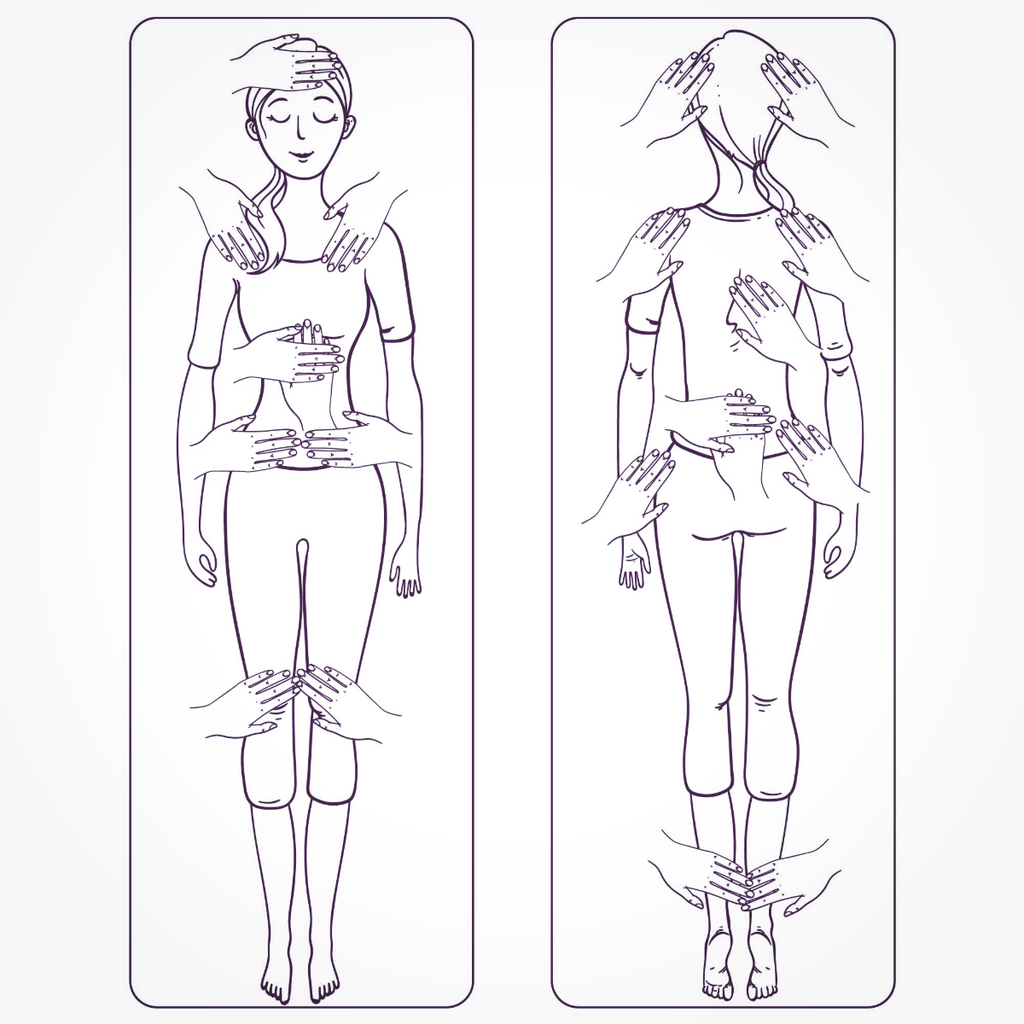
These are broad regions rather than rigid requirements.
When working around the torso, abdomen, hips, or other potentially sensitive areas, hands-off practice is often the clearest and most comfortable choice unless appropriate touch has been specifically discussed and agreed upon.
You do not have to cover every part of the body.
You do not have to spend exactly the same amount of time at every position.
A hand-position sequence is a framework, not a test.
Its purpose is to help you practice consistently while you are learning.
5. Complete the Session
When the session feels complete—or when the agreed amount of time has passed—pause before moving away.
You may bring your hands into Gassho and take a quiet breath.
Allow yourself to acknowledge the completion of the practice.
Then gently let the recipient know that the session has ended.
Give them time to become fully alert before sitting or standing.
There is no need to rush the transition.
Do You Need to Feel Reiki in Your Hands?
No.
Some practitioners describe warmth, tingling, pulsing, heaviness, coolness, or other sensations in their hands during Reiki.
You may experience these sensations.
You may not.
Either is acceptable.
Physical sensations can arise for many reasons, and you do not need to determine exactly what each sensation means.
A warm hand does not automatically tell you something about the recipient’s health.
Tingling does not automatically identify an “energy blockage.”
A change in sensation does not give you diagnostic information.
You can simply notice:
My hands feel warm.
I notice tingling.
This position feels different.
Then continue practicing.
Learning to observe without immediately creating a story around every sensation is a valuable skill.
What If You Feel Drawn to a Particular Area?
As you gain experience, you may occasionally feel inclined to remain at one hand position longer than another.
Within Reiki practice, practitioners sometimes describe this as intuition or sensitivity to Reiki.
You can allow some flexibility while remaining humble about what the experience means.
For example, you might notice:
I feel like staying here for another few minutes.
That is very different from concluding:
There must be something medically wrong here.
The first is an observation about your own experience.
The second is a claim about another person’s body.
Keep the distinction clear.
If you choose to remain at a position longer, you do not need to diagnose or explain why.
Simply continue the practice.
You Do Not Need to Direct the Outcome
When someone receives Reiki, you may naturally hope that they feel peaceful, relaxed, supported, or restored.
That intention can come from genuine care.
But be careful not to turn caring into responsibility for producing a particular result.
You cannot guarantee how another person will experience Reiki.
One person may become deeply relaxed.
Another may feel restless.
Someone may notice warmth.
Someone else may feel nothing unusual.
A recipient might enjoy the session very much.
Another might decide Reiki is not for them.
All of these possibilities are allowed.
Your responsibility is not to create the “correct” experience.
Your responsibility is to practice responsibly.
This means offering Reiki without promising an outcome and without measuring your worth as a practitioner by the recipient’s reaction.
Avoid Diagnosing or Interpreting the Recipient
After a session, a beginner may feel tempted to tell the recipient everything they noticed.
Perhaps your hands felt warm near their shoulders.
Perhaps you suddenly felt emotional.
Perhaps an image appeared in your mind.
Perhaps you thought about a particular chakra.
You may wonder whether you should explain what these experiences “mean.”
Usually, restraint is wiser.
Your internal experience does not automatically describe the recipient’s physical, emotional, psychological, or energetic condition.
Avoid statements such as:
“Your heart chakra is blocked.”
“I could feel trauma stored here.”
“Your liver energy felt weak.”
“I sensed that you have an illness.”
“Your body told me that you need to…”
Statements like these can carry much more authority than the practitioner intends, particularly when a recipient is vulnerable or searching for answers.
Instead, allow the recipient to describe their own experience.
You can listen without needing to interpret it for them.
When Someone Mentions a Health Concern
People may sometimes seek Reiki while they are experiencing pain, illness, emotional difficulty, stress, or other health concerns.
You do not need to reject someone simply because they are dealing with a health issue.
But your role must remain clear.
Reiki should not be presented as a substitute for appropriate medical, psychological, veterinary, or other professional care.
If someone tells you about a health concern, you do not need to diagnose it, explain its energetic cause, recommend stopping treatment, or promise that Reiki will resolve it.
You can simply acknowledge what they have shared and keep the Reiki practice within its appropriate scope.
Reiki can remain what it is within this manual:
a spiritual and self-care practice offered alongside—not in place of—appropriate professional care when such care is needed.
Practicing With Friends and Family
Level 1 students often begin by offering Reiki to people they already know.
This can be a gentle way to gain experience.
However, familiarity does not remove the need for boundaries.
Your partner does not automatically consent to Reiki.
Your friend does not need Reiki simply because they are having a difficult day.
Your family member does not have to believe in Reiki because you practice it.
Ask first.
Respect skepticism.
Respect refusal.
Respect differences in spiritual beliefs.
One of the most compassionate things a Reiki practitioner can learn is that not everyone needs to share their relationship with Reiki.
You can value your practice without needing to persuade anyone else of its value.
Keep Your Early Practice Simple
As you begin offering Reiki to others, there may be a temptation to add more.
More techniques.
More spiritual concepts.
More tools.
More interpretations.
More rituals.
But Level 1 is an invitation to become comfortable with simplicity.
You can offer a beautiful Reiki practice with very little:
A quiet space.
A willing recipient.
Your hands.
Your attention.
Your Reiki practice.
Your respect for the person in front of you.
That is enough.
The deeper skills of Reiki are often not found in doing more.
They are found in becoming more present with what you are already doing.
A Simple Practice Framework
When you are beginning, you can remember the session through five simple steps:
Ask → Settle → Offer → Observe → Close
Ask
Obtain consent and understand the recipient’s preferences.
Settle
Ground yourself and become present.
Offer
Practice Reiki using comfortable, appropriate hand positions.
Observe
Notice your own experience without diagnosing or forcing an interpretation.
Close
End the practice gently and give the recipient time to transition.
You do not need to memorize an elaborate script.
With repetition, the structure will become increasingly natural.
Reflection After Practicing With Another Person
After your first few sessions, take a few minutes to reflect privately.
You might ask yourself:
- Was I able to remain present?
- Did I feel pressure to make something happen?
- Was I comfortable with silence?
- Did I respect the recipient’s preferences and boundaries?
- Did I notice sensations without immediately interpreting them?
- Was I tempted to diagnose or explain the recipient’s experience?
- Did I feel responsible for whether they enjoyed the session?
- What felt natural?
- What felt uncertain?
- What would I like to practice differently next time?
The purpose is not to judge your performance.
It is to develop awareness.
Each session can teach you something about how you relate to another person while practicing Reiki.
From Technique to Relationship
Learning where to place your hands is relatively straightforward.
Learning how to be with another person is deeper.
When someone agrees to receive Reiki, they are allowing you into a quiet and potentially vulnerable space.
How you enter that space matters.
Your technique matters.
But so do your patience, boundaries, humility, communication, and ability to respect another person’s autonomy.
This is where Reiki begins to become more than a sequence of hand positions.
The practice becomes relational.
You are no longer practicing only with yourself.
You are learning how to remain grounded in your own presence while allowing another person to have an experience that belongs entirely to them.
That brings us to the next part of Level 1.
Looking Ahead
In the next chapter, Holding Space for Others, we will explore what happens beyond the physical structure of a Reiki session.
How do you listen without trying to fix?
How do you remain compassionate without absorbing responsibility for another person’s emotions?
How do you respond when someone becomes emotional?
How do you maintain clear practitioner boundaries?
And how can you create a space in which another person feels respected without positioning yourself as an authority over their inner experience?
These skills extend far beyond Reiki.
They are part of learning how to meet another human being with presence, dignity, and care.