
Reiki Master Level
Chapter 9 — Distance Reiki Attunement Methods
Attunement Beyond Shared Place

A Reiki attunement does not require the teacher and student to occupy the same physical space.
Across Reiki lineages, distance attunements have taken many forms. Some teachers work with an empty chair or another physical surrogate. Some visualize the student before them. Others use a photograph, written name, direct intention, or the space between their hands.
The teacher and student may participate from different places and, through a call-in method, at different times.
Distance changes the outer form of the ceremony. It does not change the Reiki level being offered or the importance of clear communication, consent, intention, and receptivity.
The method gives the teacher a form through which to focus. It is not the source of Reiki.
Scheduled and Call-In Attunements

Distance attunements may be offered through two general timing structures.
Scheduled Distance Attunement
The teacher and student agree upon a date and time.
At the arranged time, the student rests in a quiet place while the teacher conducts the attunement through a surrogate, visualization, the space between the hands, or another chosen method.
A telephone or video call is optional. The distance connection does not depend upon a digital call remaining open.
Call-In Distance Attunement
The teacher prepares the attunement in advance for a named student and Reiki level.
The student later chooses a quiet time and consciously opens to receive it. Teacher and student therefore do not need to participate at the same time.
This is commonly described as a call-in attunement. Some teachers prepare it through a Chi Ball method. It is a contemporary distance practice rather than an original procedure attributed to Mikao Usui.
Before preparing a call-in attunement, tell the student how it may be received and whether there is a particular receiving period.
Consent, Identification, and Privacy
Before preparing any distance attunement, confirm:
- the student’s identity
- the Reiki level being offered
- whether the attunement is scheduled or call-in
- the receiving time or call-in period
- how the student should prepare
- how you will communicate afterward
Do not prepare an attunement for someone simply because you believe it would benefit them.
If you intend to use a photograph, obtain permission. A photograph found online or through social media should not automatically be treated as available for Reiki practice.
Agree upon how photographs, written names, and other personal information will be stored and when they will be deleted.
Distance does not make consent, privacy, or clear communication less important.
The Physical Surrogate Method

A physical surrogate provides a form around which the teacher can perform the attunement.
You may use:
- an empty chair
- a cushion
- a folded blanket
- a teddy bear
- another simple object that provides a clear spatial reference
The object is not the student. It temporarily represents the student so that the teacher can move through the familiar crown, forehead, palms, heart, and closing-crown pathway.
Before beginning, hold an intention such as:
For the duration of this attunement, this surrogate represents [student’s name], who is receiving the Reiki [level] attunement.
When the ceremony is complete, release the surrogate from its symbolic role. It becomes an ordinary chair, cushion, teddy bear, or object again.
The Visualization Method
In the visualization method, bring the student into your awareness and allow a simple impression of them to arise.
You may imagine:
- the student seated before you
- yourself entering the student’s receiving space
- the student within a quiet mental Reiki space
- a simple human form representing the student
The image does not need to be vivid or anatomically precise. You do not need to see the student’s face clearly or maintain a detailed body throughout the ceremony.
A faint impression is sufficient.
If the image fades, return gently to the student’s name and the intention of the attunement. Do not become tense or assume that the connection has been lost.
Visualization supports attention. It is not the source of the attunement.
Photograph, Written Name, or Location
A photograph, written name, or awareness of the student’s location may help bring the student into focus.
These are connection aids rather than complete attunement procedures. They may be used together with visualization, a surrogate, the space between the hands, or direct intention.
Photograph
A photograph provides a visual reference and may make it easier to bring the student’s general form into awareness.
It is not necessary. A photograph does not make the connection stronger or the attunement more valid.
Written Name
A written name clearly identifies the student.
Place the name before you, bring the student into awareness, and continue with your chosen distance method.
The paper does not need to function as an anatomical representation of the student.
Location
Knowing the student’s city, home, or receiving space may help you imagine being present with them.
Some teachers use a photograph of the room or chair where the student will receive. Others simply bring the location to mind.
The location supports attention. It does not need to be visualized precisely.
The Space Between the Hands
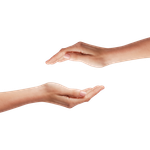
The space between your hands may act as a simple surrogate for the student.
Bring the student into awareness and hold the intention that, for the duration of the attunement, the space between your hands represents them.
You may hold both hands facing one another. You may also rest the lower hand on your lap or a table while working with the upper hand. This can help the body remain relaxed during a longer ceremony.
Within the space, allow a general impression of the student to arise. The crown, forehead, palms, heart, and closing crown may be held as simple areas of awareness.
The representation does not need anatomical detail.
This method can be especially helpful when you want a clear focus without moving around a physical surrogate.
Direct Intention
A distance attunement may also be offered through direct intention without maintaining a detailed visualization or physical surrogate.
Identify the student and Reiki level clearly. Connect with Reiki and intend to be present with the student.
A simple or faint awareness of the student may arise naturally. There is no need to force it into a particular form.
Direct intention and visualization often overlap. Intention identifies the student and the attunement being offered. Visualization may give that intention a mental form.
Clarity does not require strain.
Chi Ball as a Call-In Method
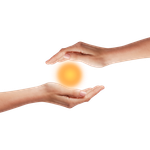
A Chi Ball is used in some contemporary distance practices as a focused container for an attunement prepared in advance.
The word ball describes the form through which the teacher gathers and holds the intention. It does not need to be understood as a physical object or a literal parcel of energy.
The teacher may visualize a sphere of light or Reiki between their hands and prepare the attunement for a named student and level.
The student later opens consciously to receive it according to the arrangement established beforehand.
Chi Ball procedures vary among teachers and lineages. What matters is that:
- the student is clearly identified
- the Reiki level is clearly identified
- the student has agreed to receive
- the receiving instructions are clearly communicated
- the teacher releases personal effort after the preparation is complete
A Chi Ball is a contemporary asynchronous form. It should not be presented as an original Usui procedure or as the only valid way to offer a call-in attunement.
Methods May Be Combined
These methods do not need to remain completely separate.
You may:
- place a photograph on an empty chair
- put a written name beside a teddy bear
- visualize the student while working with the space between your hands
- bring the student’s location to mind while using direct intention
- use a photograph to help form an initial impression and then set it aside
The purpose of combining methods is not to make the attunement more powerful or elaborate. Use only what helps you remain clear and present.
Respecting Different Forms
Distance attunement is taught differently across Reiki lineages.
Surrogate and visualization methods are widely used within Western Reiki teaching. Photographs, written names, direct intention, and the space between the hands are also used as connection aids. Chi Ball and asynchronous call-in attunements are contemporary adaptations.
These descriptions help us understand how practices developed. They do not rank their spiritual value.
A method is not automatically more powerful because it is elaborate, traditional, or visually impressive. A newer method is not automatically invalid because its form developed later.
What matters is whether the form helps the teacher become quiet, connect with Reiki, hold the student and level clearly in awareness, and allow Reiki to lead.
As with in-person attunement, the form may matter less and less as practice deepens.
Choosing a Method

You do not need to master every distance-attunement method.
Begin with one that feels clear and natural.
A physical surrogate may help if you prefer movement and spatial structure.
Visualization may feel natural if mental imagery arises easily for you.
A photograph or written name may help you maintain a clear connection with the student.
The space between the hands may suit a quieter and more compact ceremony.
Direct intention may become natural as your experience deepens.
A call-in method may be useful when teacher and student cannot participate at the same time.
Choose the method that allows you to remain attentive without becoming preoccupied with maintaining the form.
Rehearsing the Method
Before adding the complete attunement procedure, practise bringing the student into awareness through your chosen method.
You may rehearse:
- establishing and releasing the symbolic role of a surrogate
- allowing a simple visualization to arise without forcing detail
- working with a photograph or written name
- holding the student within the space between your hands
- returning to the student’s name when your attention wanders
- remaining present when the mental image changes or fades
The purpose is not to produce a convincing illusion that the student is physically present.
The method simply gives your attention somewhere to rest.
Reflection
- Which distance-attunement method allows me to remain most present, clear, and receptive?
- Can I use a representation of the student without mistaking the representation for the student?
- Can I respect different attunement forms without needing to declare one universally superior?
The Path Ahead

Once you have chosen a method, the next step is to bring the complete distance attunement together.
The following chapter presents the structure from preparation and connection through the level-specific procedure, closing, and release:
Structuring a Distance Reiki Attunement
Reiki Level 3 Manual
- Chapter 1 — From Practising Reiki to Embodying the Practice
- Chapter 2 — The Master Symbol: Dai Ko Myo
- Chapter 3 — Reiki, Emptiness & the Clear Conduit
- Chapter 4 — Reiju: The Japanese Roots of Reiki Attunement
- Chapter 5 — The Shared Attunement Pathway
- Chapter 6 — In-Person Attunement for Reiki Level 1
- Chapter 7 — In-Person Attunement for Reiki Level 2
- Chapter 8 — In-Person Attunement for Reiki Master Level
- Chapter 9 — Distance Reiki Attunement Methods
- Chapter 10 — Structuring a Distance Reiki Attunement
- Chapter 11 — The Master’s Ongoing Practice
Come as you are.
Learn what calls to you, move at your own rhythm,
and return whenever you need a quieter place to begin again.