
Symbols as Doorways Into Reiki
One of the most recognizable features of Reiki Level 2 is the introduction of the Reiki symbols.
For many students, this is the moment that makes Level 2 feel distinctly different from Level 1.
Until now, your practice has centred on presence, self-Reiki, foundational techniques, attunement, in-person practice, and learning to become a clear conduit for Reiki.
Level 2 introduces another dimension:
working consciously with sacred symbols.
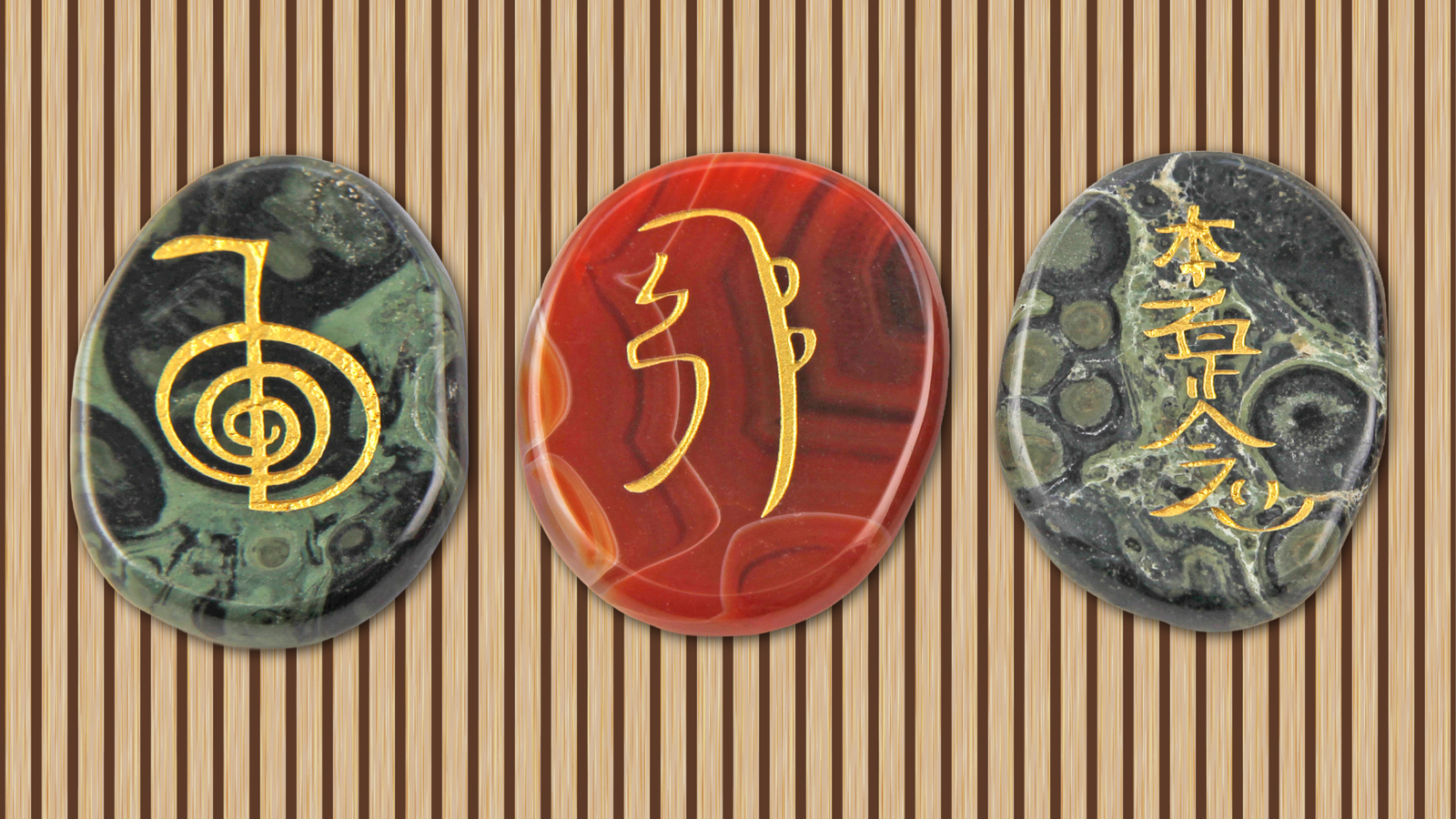
The three symbols most commonly taught at this stage are:
- Cho Ku Rei
- Sei He Ki
- Hon Sha Ze Sho Nen
Different Reiki lineages may spell, pronounce, draw, interpret, or teach the symbols somewhat differently.
That variation is part of the living transmission of Reiki.
The goal of this chapter is therefore not to insist upon one rigid interpretation.
Instead, we will explore the symbols as they are traditionally approached within Reiki:
as energetic and spiritual tools that help the practitioner focus, deepen, and extend Reiki practice.
The symbols are not merely decorations.
They are not simply ideas to memorize.
And although they can certainly function as focuses for intention and attention, Reiki tradition attributes something deeper to them.
There is mystery in the symbols.
You do not need to explain that mystery away in order to practice responsibly.
What Is a Reiki Symbol?
A Reiki symbol has a visible form.
It has a name.
It has traditional uses.
And through attunement and practice, it becomes part of the practitioner’s relationship with Reiki.
At one level, symbols are familiar to us in ordinary life.
A wedding ring is physically an object, yet it may carry love, memory, relationship, and commitment.
A national flag is fabric, yet it may evoke identity, history, belonging, grief, or devotion.
A handwritten letter is paper and ink, yet it may carry the emotional presence of someone we love.
The visible object carries something greater than its material form alone.
Reiki symbols can also function in this way—but within Reiki practice, their significance goes further.
Traditionally, these symbols are understood as carrying or invoking particular qualities of Reiki energy.
Cho Ku Rei is associated with focusing and strengthening Reiki.
Sei He Ki is associated with mental and emotional dimensions of practice.
Hon Sha Ze Sho Nen is associated with connection beyond ordinary physical distance and, in many traditions, beyond ordinary limitations of time.
For the Reiki practitioner, the symbol therefore becomes more than a reminder.
It can become a doorway.
A meeting point between form and energy.
Between intention and receptivity.
Between the visible gesture and something that may not be visible at all.
Through teaching, attunement, repetition, intention, and experience, the practitioner develops a relationship with the symbol.
Eventually, the symbol may no longer feel like something you are merely drawing.
It may begin to feel like something you are entering.
The Mystery and Power of Reiki Symbols
The word power needs to be understood carefully in Reiki.
The symbols are not intended to increase the practitioner’s ego, personal authority, or ability to dominate another person.
Their power does not mean:
I now possess greater personal force.
Instead, their traditional power lies in how they help the practitioner become a clearer conduit for Reiki.
This becomes especially evident at Level 2.
Through Hon Sha Ze Sho Nen, for example, Reiki practice is traditionally understood to no longer depend upon practitioner and recipient sharing the same physical space.
Distance may separate two people geographically.
The practitioner may be in one country while the recipient is in another.
Yet within the spiritual framework of Reiki, Reiki can still be offered.
This is one of the mysteries at the heart of Level 2.
The symbol does not make you omnipotent.
Rather, the symbol participates in a practice in which Reiki itself is understood as not being restricted in the same way that ordinary physical contact is restricted.
That distinction matters.
The power belongs to Reiki—not to the practitioner’s ego.
The symbol helps you enter into relationship with that larger field of practice.
Can Science Explain the Reiki Symbols?
At present, science has not established a mechanism demonstrating that Reiki symbols transmit a measurable form of energy across distance or time.
That does not mean you must strip Reiki of its spiritual framework in order to discuss it responsibly.
It simply means that we should be clear about the boundary between what has been scientifically demonstrated and what belongs to spiritual practice and lived experience.
Scientific inquiry works through observable, measurable, and reproducible evidence, often extending human perception through instruments far beyond our unaided five senses.
Many phenomena that human beings could not directly perceive—radio waves, microscopic organisms, infrared radiation, magnetic fields, subatomic particles—became scientifically accessible only after methods and instruments were developed to detect them.
Whether the traditional energetic framework of Reiki reflects a phenomenon that could someday be measured, a different kind of human experience, a spiritual reality outside the present scope of scientific methodology, or something else entirely remains an open question.
We do not need to manufacture an answer.
Reiki practice can leave room for mystery.
You may experience the symbols as energetically powerful.
You may observe meaningful differences in your practice when using them.
Those experiences can matter deeply without requiring you to claim that modern science has already explained why they occur.
A grounded spiritual practice can hold both statements at once:
I take my experience seriously.
And:
I remain humble about what I can objectively prove.
The Symbols Are Not Magic Buttons
Respecting the mystery of Reiki symbols does not mean treating them like magical commands.
Drawing Cho Ku Rei does not make the universe obey your wishes.
Sei He Ki does not force another person’s emotions to change.
Hon Sha Ze Sho Nen does not give you unrestricted access to another human being.
The symbols help establish and deepen Reiki practice.
They do not place Reiki under your control.
This distinction becomes increasingly important as you work with them.
You use the symbol.
You establish your intention.
You become receptive.
You allow yourself to become a clear conduit.
Then you release the outcome.
The practitioner invokes.
The practitioner offers.
Reiki unfolds according to what is appropriate for the recipient.
Respecting the Reiki Symbols
Historically, many Reiki schools treated the symbols as teachings shared only after students had reached the appropriate level and received the corresponding attunement.
Some Reiki traditions continue to preserve this degree of privacy.
Others teach the symbols more openly.
Today, the visual forms can easily be found in books and online.
But seeing a symbol is not the same as being trained to work with it.
The deeper relationship develops through:
- attunement;
- teaching;
- careful practice;
- repetition;
- intention;
- meditation;
- and personal experience.
Within Moon Petal Healing, the symbols are approached with reverence without fear.
Treat them as meaningful.
Learn them carefully.
Practice them sincerely.
But do not become frightened that an imperfect line or imperfect pronunciation will somehow ruin your Reiki practice.
Respect should deepen practice.
It should not create anxiety.
How to Draw and Invoke a Reiki Symbol
When beginning Level 2, it is helpful to establish a consistent method.
Within this manual, we recommend a simple approach:
Draw the symbol slowly and deliberately while silently repeating its name three times.
For example, when drawing Cho Ku Rei:
draw the symbol while silently saying:
Cho Ku Rei.
Cho Ku Rei.
Cho Ku Rei.
The repetition helps bring together:
the form of the symbol,
the name of the symbol,
and
your intention to work with its Reiki quality.
You can use the same method with Sei He Ki and Hon Sha Ze Sho Nen.
The name may be spoken silently rather than aloud, particularly when practicing with another person.
The purpose of repeating the name three times is not mechanical perfection.
It is to help your attention settle fully into the invocation.
Over time, you may find that simply thinking of the symbol is enough to bring you immediately into relationship with its quality.
But while learning, take your time.
Draw.
Invoke.
Pause.
Receive.
Form, Name, Intention, Reiki
A useful way to understand symbol practice is through four elements:
Form
The visual shape and movement of the symbol.
Name
The traditional name associated with it.
Intention
The context in which you are invoking the symbol.
Reiki
The energetic and spiritual practice into which the symbol opens.
The first three belong partly to what you are doing.
The fourth reminds you that you are not manufacturing the process through personal will.
You draw.
You invoke.
You become receptive.
And then you allow Reiki.
Cho Ku Rei
The Power Symbol

Cho Ku Rei is commonly known as the Power Symbol.
It is traditionally associated with strengthening, focusing, or concentrating Reiki.
Different lineages interpret its name and energetic quality somewhat differently.
Rather than becoming overly attached to one English translation, it may be more useful to experience Cho Ku Rei through practice.
Its quality can be contemplated as:
Here.
Now.
Reiki.
It draws the practice into focus.
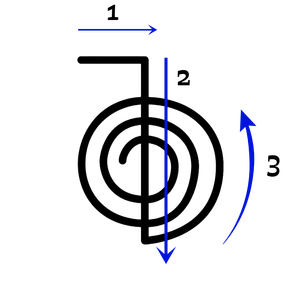
This illustration shows the stroke order for drawing Cho Ku Rei. Follow the numbered lines in sequence, beginning with 1.
Traditional Uses of Cho Ku Rei
Cho Ku Rei may be used:
- at the beginning of self-Reiki;
- before an in-person Reiki session;
- before or after another Reiki symbol;
- during meditation;
- over particular hand positions;
- as part of distance Reiki practice;
- when completing a session;
- or whenever you feel called to bring greater focus into Reiki.
Many practitioners describe Cho Ku Rei as strengthening or amplifying Reiki.
Within the spiritual framework of the practice, it may be experienced as bringing Reiki more strongly into the present focus.
Again, the practitioner is not generating this power personally.
You are invoking a Reiki symbol associated with the focusing of Reiki.
Power Without Ego
The phrase Power Symbol can easily be misunderstood.
The power is not:
My Reiki is stronger than yours.
It is not:
I now have greater spiritual authority.
It is not:
I can force Reiki to do what I want.
Instead, Cho Ku Rei can remind you that Reiki does not depend upon personal effort.
Your task is to become clearer.
Quieter.
More receptive.
The less the ego tries to become the source, the easier it becomes to understand the traditional Reiki idea of the practitioner as conduit.
Practicing With Cho Ku Rei
Begin with Gassho.
Settle your breath.
When you are ready, draw Cho Ku Rei.
As you draw it, silently repeat:
Cho Ku Rei.
Cho Ku Rei.
Cho Ku Rei.
Then pause.
Notice.
Do not immediately move on.
Feel the moment after the symbol.
You might then begin self-Reiki.
Notice whether your experience feels different from your ordinary Level 1 practice.
Perhaps you sense warmth.
Perhaps your attention becomes sharper.
Perhaps you feel a deepened stillness.
Perhaps nothing obvious happens.
All are acceptable.
Practice first.
Meaning often deepens afterward.
Sei He Ki
The Mental and Emotional Symbol
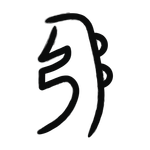
Sei He Ki is commonly known as the Mental and Emotional Symbol.
It is traditionally used when Reiki practice is being brought toward mental, emotional, or habitual dimensions of experience.
It may be used in practices involving:
- emotional balance;
- stress;
- habits;
- patterns of thought;
- personal reflection;
- inner harmony;
- self-compassion;
- or mental and emotional intention.
Within Reiki tradition, Sei He Ki carries a particular energetic quality associated with these dimensions.
But this does not make the Reiki practitioner a psychotherapist or give them access to another person’s private psychological world.
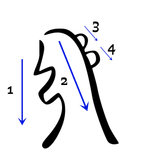
This illustration shows the stroke order for drawing Sei He Ki. Follow the numbered lines in sequence, beginning with 1.
Working With Emotion Through Reiki
Imagine that you feel anger, sadness, fear, or uncertainty.
You do not have to eliminate the emotion.
You do not have to judge it as spiritually undesirable.
Instead, you can allow it to be present while bringing Reiki into the experience.
Begin with Gassho.
Draw Sei He Ki.
Silently repeat:
Sei He Ki.
Sei He Ki.
Sei He Ki.
Then offer self-Reiki.
Rather than saying:
Make this feeling disappear,
you might simply hold:
May Reiki support what is needed here.
Then release the outcome.
This allows the symbol to deepen the practice without turning it into a demand.
Emotional Reiki Is Not Psychotherapy
Working with Sei He Ki does not qualify a Reiki practitioner to diagnose or treat psychological conditions.
You are not using the symbol to uncover hidden trauma.
You are not reading someone’s subconscious.
You are not deciding the psychological cause of their illness.
You are not commanding their emotions to change.
You offer Reiki.
You hold space.
And you allow the person’s experience to remain their own.
When appropriate professional mental health support is needed, Reiki can remain complementary to that care rather than replacing it.
Hon Sha Ze Sho Nen
The Distance Symbol
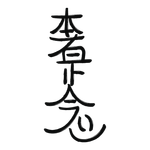
Hon Sha Ze Sho Nen is commonly known as the Distance Symbol.
It is one of the central teachings of Reiki Level 2.
Traditionally, it allows Reiki practice to extend beyond ordinary physical proximity.
The practitioner and recipient do not need to occupy the same room.
Within Reiki traditions, Hon Sha Ze Sho Nen is also frequently associated with working beyond ordinary conceptions of time—for example, practices involving past experiences or future situations.
This is where some of the mystery of Reiki Level 2 becomes especially apparent.
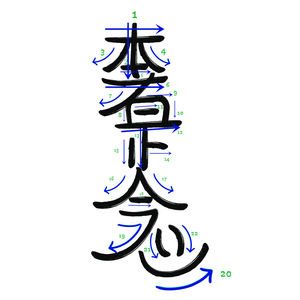
This illustration shows the stroke order for drawing Hon Sha Ze Sho Nen. Follow the numbered lines in sequence, beginning with 1.
Reiki Beyond Physical Distance
In Level 1, practitioner and recipient share a physical space.
You can see the person.
You may place your hands gently on or above their body.
Distance Reiki changes that structure.
The person may be hundreds or thousands of kilometres away.
Yet within Reiki’s traditional energetic framework, physical distance does not prevent Reiki from being offered.
Hon Sha Ze Sho Nen becomes the symbolic doorway through which this practice is established.
You might contemplate its quality as:
connection beyond separation.
This does not mean the practitioner has developed supernatural personal reach.
The practitioner remains a conduit.
The Reiki symbol supports a form of practice that traditionally understands Reiki as not being confined by the same spatial boundaries as physical touch.
Distance Does Not Remove Consent
Mystery does not erase ethics.
The fact that Hon Sha Ze Sho Nen is traditionally used to offer Reiki across distance does not give the practitioner unlimited permission to work with anyone.
Whenever reasonably possible, obtain consent.
Someone being physically absent does not make them energetically available to you without their agreement.
Oneness does not erase autonomy.
Spiritual connection does not erase boundaries.
The greater the apparent freedom of the practice, the more consciously we should practice responsibility.
Hon Sha Ze Sho Nen and Time
Many Reiki traditions also work with Hon Sha Ze Sho Nen in relation to past or future situations.
This does not require believing that the practitioner literally rewrites history or controls the future.
Instead, Reiki may be offered within a spiritual practice directed toward a relationship with another point in time.
For the past, you might hold an earlier experience gently in awareness while offering Reiki.
For the future, you might offer Reiki toward an upcoming situation without demanding a particular result.
For example:
May Reiki support me in meeting this situation with clarity and steadiness.
rather than:
Reiki must make this situation happen exactly as I want.
The distinction remains:
connection without control.
A Powerful Layered Symbol Practice
Once you have begun learning the individual symbols, you may explore a more concentrated Level 2 practice by drawing the symbols one over another in sequence.
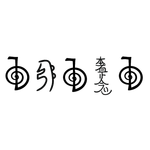
You may use the following sequence:
1. Draw Cho Ku Rei
As you draw it, silently repeat:
Cho Ku Rei.
Cho Ku Rei.
Cho Ku Rei.
Allow the practice to become focused.
2. Draw Sei He Ki over Cho Ku Rei
Silently repeat:
Sei He Ki.
Sei He Ki.
Sei He Ki.
Allow the mental and emotional quality of Reiki to enter the practice.
3. Draw Cho Ku Rei again over Sei He Ki
Silently repeat:
Cho Ku Rei.
Cho Ku Rei.
Cho Ku Rei.
Allow Cho Ku Rei to focus and strengthen the practice again.
4. Draw Hon Sha Ze Sho Nen over Cho Ku Rei
Silently repeat:
Hon Sha Ze Sho Nen.
Hon Sha Ze Sho Nen.
Hon Sha Ze Sho Nen.
Allow the practice to open beyond ordinary physical separation.
5. Draw Cho Ku Rei over Hon Sha Ze Sho Nen
Silently repeat:
Cho Ku Rei.
Cho Ku Rei.
Cho Ku Rei.
Then pause.
Do not immediately rush onward.
Allow yourself to become quiet.
Become receptive.
And offer Reiki.
The completed sequence is:
Cho Ku Rei
→ Sei He Ki
→ Cho Ku Rei
→ Hon Sha Ze Sho Nen
→ Cho Ku Rei
You may think of Cho Ku Rei as repeatedly bringing focus and Reiki presence into the sequence while the other symbols introduce their particular dimensions.
This can become a powerful ritual for Level 2 practice, particularly when establishing distance Reiki.
But remember:
The sequence is not powerful because you are forcing more energy into the recipient.
Its power lies in the Reiki practice it helps you enter.
Draw carefully.
Invoke each symbol.
Then release the urge to control what happens next.
Layering Symbols Does Not Mean “More Is Always Better”
Once you learn a sequence like this, it can be tempting to assume that five symbol invocations must always be stronger than one.
That is not necessarily the best way to understand Reiki.
Sometimes one symbol is appropriate.
Sometimes none is needed.
Sometimes the full layered sequence helps you enter deeply into practice.
The question is not:
How many symbols can I use?
The question is:
What supports the Reiki practice I am entering?
Symbols should deepen your relationship with Reiki rather than turn Reiki into a complicated formula.
Let Your Relationship With the Symbols Evolve
Different Reiki lineages teach different ways of combining and sequencing the Level 2 symbols.
In some traditions, Cho Ku Rei is used first to activate, strengthen, or prepare the practice before another symbol is introduced. In others, practitioners may be taught somewhat different sequences or applications.
At this stage, it is helpful to begin with the method you have been taught and practice it consistently.
Learn the forms.
Learn the sequence.
Invoke the symbols with attention.
Allow familiarity to grow.
Then, as your Reiki practice becomes more confident and intuitive, you may notice that your relationship with the symbols begins to change.
You may develop a natural sense of how you prefer to work with them.
You may find yourself using certain combinations more often.
You may discover that simply bringing a symbol into awareness is enough to enter its quality of practice.
You may eventually feel less dependent upon consciously drawing the symbols at all.
Or the opposite may happen.
You may come to love the ritual of drawing them and choose to make the symbols a steady, central part of your Reiki practice for years to come.
There is no need to decide in advance which direction your practice should take.
The symbols are tools within Reiki.
At first, tools give us structure.
With experience, the relationship becomes more fluid.
What matters is not whether you use the symbols more or less as you advance.
What matters is whether they continue to support a practice that is present, receptive, respectful, and free from the need to control Reiki.
Learn the form first.
Then allow experience to teach you how the form lives within your practice.
Learn One Symbol at a Time
Before relying heavily on combinations, become familiar with each symbol individually.
Spend time with Cho Ku Rei.
Draw it repeatedly.
Silently repeat its name three times while drawing it.
Use it in self-Reiki.
Then explore Sei He Ki in the same way.
Then Hon Sha Ze Sho Nen.
Notice how your experience changes.
Notice whether the symbols begin to feel different from one another.
Notice whether one evokes a particular quality of stillness, focus, expansiveness, or connection.
You are learning through practice, not only through explanation.
What If You Cannot Feel the Symbols?
Do not force an experience.
Some practitioners describe strong energetic sensations when invoking Reiki symbols.
They may feel:
- warmth;
- tingling;
- pressure;
- vibration;
- spaciousness;
- expansion;
- changes in breathing;
- emotional movement;
- or a distinct sense of presence.
Another practitioner may experience something far subtler.
Do not turn sensitivity into a hierarchy.
A symbol does not become valid only when you feel dramatic sensations.
Continue practicing.
Your relationship may deepen gradually.
Do the Symbols Need to Be Drawn Perfectly?
Learn them carefully.
The process of repeated drawing helps establish familiarity.
However, different Reiki lineages already preserve variations in some symbol forms.
Do not become so frightened of small imperfections that the symbol becomes a source of tension.
When learning:
slow down.
Follow the form you have been taught.
Repeat the name three times.
Practice.
Correct mistakes when you notice them.
Then continue.
Sacredness does not require anxiety.
What If I Cannot Visualize Clearly?
Not everyone experiences mental imagery in the same way.
If visualizing a symbol is difficult, you can:
- trace it with your hand;
- draw it physically;
- visualize the movement rather than a perfect image;
- silently invoke its name;
- or bring the symbol into awareness through intention.
With repeated practice, you may discover that the symbol becomes familiar in a way that does not depend entirely on visual imagery.
You may simply know the movement.
Or feel the invocation.
Let your relationship develop naturally.
Symbol Practice Can Evolve
At Level 2, you may initially depend strongly on the symbols.
This is useful.
They are new tools, and deliberate practice helps you learn them.
But your relationship with them may change.
As Reiki becomes increasingly familiar, some practitioners find that they no longer need to consciously draw every symbol every time.
The intention may arise immediately.
The symbol may appear mentally.
Its energetic quality may feel present before the physical drawing is completed.
You may find that a simple awareness of Cho Ku Rei is enough.
Or that Hon Sha Ze Sho Nen becomes almost instantaneous when entering distance practice.
This does not mean you have “graduated beyond” the symbols.
It simply means that the tools have become internalized.
Or You May Choose to Use the Symbols More
The opposite can also happen.
The more familiar you become with Reiki, the more you may appreciate the symbols.
You may begin incorporating them more intentionally into:
- self-Reiki;
- meditation;
- distance Reiki;
- Gassho;
- Hatsurei Ho;
- journaling;
- emotional self-care;
- session preparation;
- or your closing practice.
There is no rule that spiritual development means eventually abandoning ritual.
Sometimes familiarity makes ritual more meaningful rather than less.
One practitioner may eventually use symbols sparingly.
Another may continue drawing them every day.
Both can have a deep Reiki practice.
The symbols are tools.
Your relationship with those tools is allowed to evolve.
Symbols and the Clear Conduit
Throughout Level 1, we returned repeatedly to the idea that the practitioner is a conduit for Reiki.
The symbols deepen this principle.
Cho Ku Rei does not make you more powerful.
Sei He Ki does not make you the master of another person’s emotional life.
Hon Sha Ze Sho Nen does not make you capable of personally crossing all boundaries of space and time.
Instead, the symbols help you orient yourself toward dimensions of Reiki that the tradition understands as already available within Reiki itself.
This is why symbol practice can carry both power and humility.
There is power because the practice reaches beyond what the ordinary thinking mind may expect.
There is humility because you do not claim that power as personal possession.
You become receptive.
You invoke.
You offer.
You allow.
Symbols and Non-Duality
The Reiki symbols also invite deeper contemplation of non-separation.
Cho Ku Rei can bring you fully into:
here.
Sei He Ki can invite you to meet:
the inner landscape of mind and emotion.
Hon Sha Ze Sho Nen begins questioning the apparent boundary between:
here and there.
And perhaps eventually even:
then and now.
From the ordinary perspective, these distinctions are real and necessary.
You are here.
Another person may be far away.
Yesterday is not tomorrow.
Boundaries matter.
Consent matters.
Individual lives matter.
Yet Level 2 also asks whether these ordinary distinctions tell the entire story of existence.
What if the cosmos is far more interconnected than the isolated self usually perceives?
What if consciousness, relationship, energy, and existence contain dimensions we do not yet understand?
Reiki does not require you to answer these questions intellectually.
The symbols allow you to practice within the mystery.
That may be enough.
Mystery Without Dogma
There are two extremes worth avoiding.
One says:
If science cannot currently prove this mechanism, the experience must be meaningless.
The other says:
Because I experienced something spiritually meaningful, I now know exactly how the universe works.
Reiki practice does not require either extreme.
You can remain open.
You can experience wonder.
You can work with energy.
You can regard the symbols as sacred and powerful.
You can explore distance Reiki sincerely.
And you can still say:
There are aspects of this practice I cannot fully explain.
Mystery does not weaken spiritual practice.
Sometimes mystery is part of what makes spiritual practice spiritual.
Your Symbol Journal
During Level 2, consider keeping a section of your Reiki journal specifically for the symbols.
For each practice, record:
Date
Symbol or sequence used
Intention
How the symbol was invoked
Sensations or experiences
Emotions or images that arose
Questions
Reflection
If you use the layered sequence, note that as well:
CKR → SHK → CKR → HSZSN → CKR
Over time, look back.
Has your relationship with each symbol changed?
Do you feel less dependent on the physical drawing?
Or have you developed a deeper appreciation for drawing it deliberately?
Does one symbol feel particularly meaningful?
Does the full sequence bring you into practice differently from the individual symbols?
You do not need to reach a predetermined conclusion.
Observe.
A Seven-Day Symbol Exploration
You may spend one week beginning to familiarize yourself with these teachings.
Day 1 — Cho Ku Rei
Draw the symbol while silently repeating its name three times.
Then bring it into self-Reiki.
Day 2 — Sei He Ki
Practice the same threefold invocation and explore it within emotional self-Reiki.
Day 3 — Hon Sha Ze Sho Nen
Practice drawing and invoking the Distance Symbol.
Sit quietly afterward and contemplate connection beyond physical proximity.
Day 4 — Cho Ku Rei + Sei He Ki + Cho Ku Rei
Explore the first part of the layered sequence.
Notice the quality of the practice.
Day 5 — Hon Sha Ze Sho Nen With Cho Ku Rei
Explore how the Distance Symbol feels when framed by Cho Ku Rei.
Day 6 — The Full Sequence
Practice:
Cho Ku Rei
→ Sei He Ki
→ Cho Ku Rei
→ Hon Sha Ze Sho Nen
→ Cho Ku Rei
Silently repeat each symbol’s name three times as you draw it.
Then remain in Reiki practice without forcing an outcome.
Day 7 — Integration
Choose whichever individual symbol or combination feels appropriate.
Then simply practice.
At the end of the week, ask yourself:
What did I experience when I stopped trying to decide what I should experience?
Reflection
Before continuing, consider:
- What does a Reiki symbol mean to me now?
- What is the difference between symbolic meaning and energetic experience?
- What does the “power” of the symbols mean if that power does not belong to my ego?
- How does silently invoking a symbol three times change my attention or experience?
- What do I notice when I layer the symbols?
- Can I allow Reiki to remain mysterious without exaggerating what I know?
- Can I distinguish spiritual experience from scientific proof?
- What does Hon Sha Ze Sho Nen invite me to contemplate about space and time?
- Can I set an intention without controlling an outcome?
- Am I becoming dependent on the symbols, or are they helping me become more receptive?
- Might my relationship with the symbols change as my Reiki practice deepens?
- What does it mean to become a clearer conduit for Reiki?
Let the answers evolve.
The symbols are not meant to be understood entirely in one sitting.
Their meaning grows through relationship.
Looking Ahead
You have now been introduced to the three principal symbols commonly taught at Reiki Level 2:
Cho Ku Rei — the Power Symbol, associated with focusing and strengthening Reiki.
Sei He Ki — the Mental and Emotional Symbol, associated with mental and emotional dimensions of practice.
Hon Sha Ze Sho Nen — the Distance Symbol, associated with Reiki beyond ordinary physical proximity and, within many Reiki traditions, beyond ordinary limitations of time.
You have also learned a practical method for invoking each symbol:
draw the symbol while silently repeating its name three times.
And you have been introduced to the layered sequence:
Cho Ku Rei
→ Sei He Ki
→ Cho Ku Rei
→ Hon Sha Ze Sho Nen
→ Cho Ku Rei
These are tools.
Powerful tools within Reiki practice.
But they remain tools.
As your relationship with Reiki develops, you may find yourself needing them less consciously.
Or you may discover that you love working with them and integrate them even more deeply into your practice.
Neither path is more advanced.
What matters is the relationship beneath the technique.
In the next chapter, Using Symbols in Personal Reiki Practice, we will move beyond learning their forms and begin incorporating them into self-Reiki, Gassho, meditation, emotional self-care, the Five Reiki Principles, journaling, and everyday practice.
Before using the symbols to extend Reiki outward across distance, we will first allow them to deepen the practice closest to home:
your own relationship with Reiki.