

Entering the Light of Master-Level Reiki
At Level 2, you were introduced to three Reiki symbols:
Cho Ku Rei
Sei He Ki
Hon Sha Ze Sho Nen
Each opened another dimension of Reiki practice.
Cho Ku Rei brought focus and strengthening.
Sei He Ki opened the practice toward mental and emotional harmony.
Hon Sha Ze Sho Nen carried Reiki beyond ordinary physical proximity and, in many Reiki traditions, beyond ordinary boundaries of time.
At the Master level, another symbol enters the practice:
Dai Ko Myo
大光明
Often called the Reiki Master Symbol, Dai Ko Myo holds a central place in Master-level Reiki. It is associated with spiritual illumination, deeper connection with universal life-force energy, and the attunement process.
Within the Usui Reiki lineage taught in this manual, Dai Ko Myo encompasses the qualities and functions of the three Level 2 symbols. It can therefore replace the other symbols, although you do not have to use it in this way.
Your relationship with Dai Ko Myo will develop through attunement, practice, and integration.
Before You Practice Dai Ko Myo
You may study Dai Ko Myo before receiving your Master attunement.
You may learn its name, study its form and stroke order, understand its traditional role, and prepare for Master-level practice.
Formal practice with Dai Ko Myo begins after you have received your Master attunement.
The sequence remains:
Learn → Receive → Practice → Integrate
After your attunement, return to this chapter and begin developing your relationship with the symbol through direct experience.
What Does Dai Ko Myo Mean?
Dai Ko Myo is commonly represented by three Japanese characters:
大光明
大 — Dai
Dai can mean:
great, large, vast, or expansive.
Within contemplation of Dai Ko Myo, it turns awareness beyond the limits of the individual self and toward something greater in which the individual participates.
光 — Ko
Ko means:
light, radiance, illumination, or shining.
In spiritual language, light may also suggest clarity, awareness, awakening, or the illumination of what was previously obscured.
明 — Myo
Myo can mean:
bright, clear, luminous, or illuminated.
Within Dai Ko Myo, it reinforces the sense of clarity and radiant illumination.
大光明 — Great Shining Light
Taken together, Dai Ko Myo is commonly rendered as:
Great Shining Light
Great Bright Light
or
Great Radiant Light
The phrase points toward a dimension of Reiki that is expansive, luminous, and deeply connected with spiritual awareness.
Some Reiki teachings describe Dai Ko Myo as connecting the practitioner with the “highest vibration of Reiki” or the “highest vibration of the cosmos.”
Within Reiki, this points toward the most subtle, expansive, and encompassing dimension of universal life-force energy. It invites the practitioner to release personal control and become increasingly receptive to the greater wholeness of Reiki.
The practitioner does not own the great light or become its source.
The practitioner remains a conduit.
An Integrating Master Symbol
Dai Ko Myo encompasses the qualities associated with the Level 2 symbols:
- the focus and strengthening associated with Cho Ku Rei;
- the mental and emotional harmony associated with Sei He Ki;
- and the connection beyond ordinary physical proximity associated with Hon Sha Ze Sho Nen.
It is not merely the sum of three separate symbols. Rather, it gathers these dimensions within a broader Master-level expression of Reiki.
Focus.
Harmony.
Connection.
Spiritual illumination.
All are held within the Great Shining Light.
Drawing and Invoking Dai Ko Myo
After receiving your Master attunement, learn the Dai Ko Myo form transmitted through your Usui Reiki training.
The illustration below shows the stroke order. Follow the numbered lines in sequence, beginning with 1.

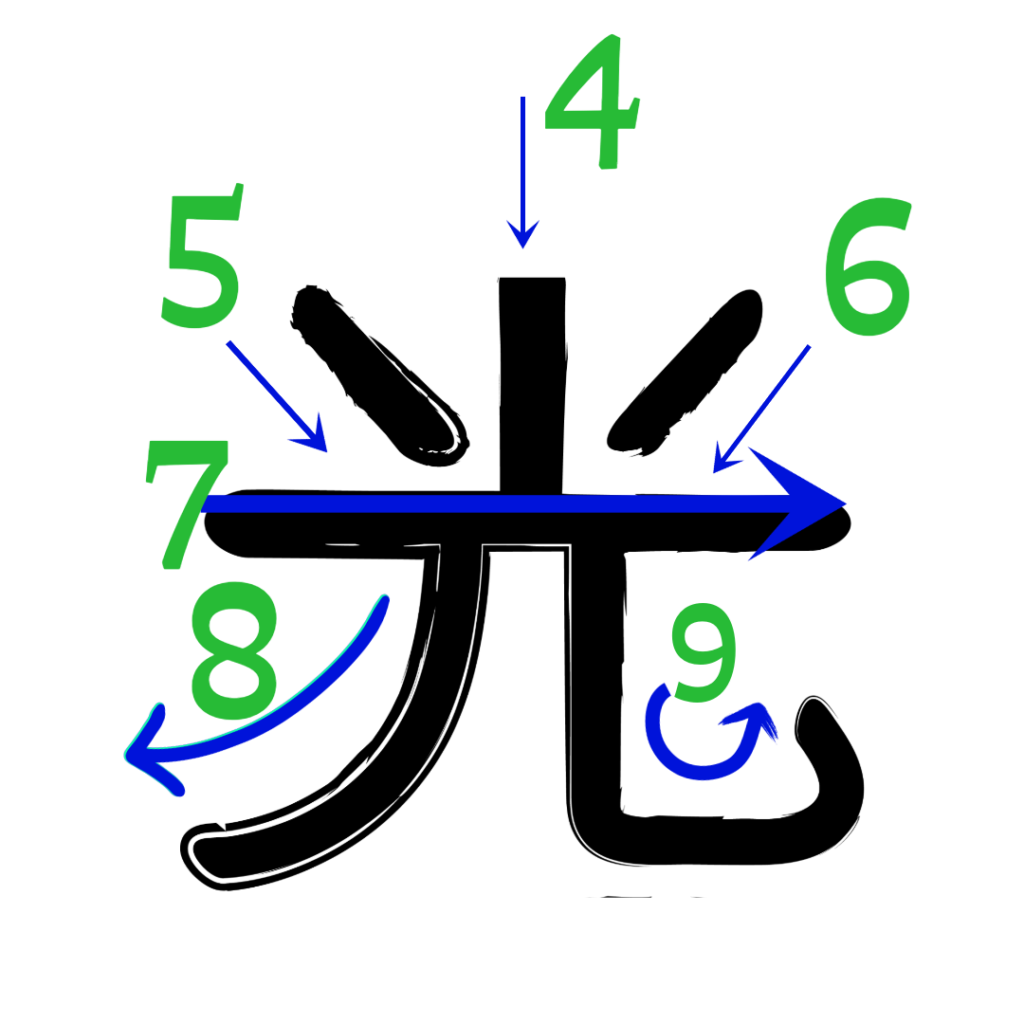

To invoke Dai Ko Myo:
- Draw the symbol once.
- Intonate its name three times:
Dai Ko Myo.
Dai Ko Myo.
Dai Ko Myo.
- Continue directly into your Reiki practice and allow Reiki to flow.
During silent practice, you may repeat the name inwardly.
You may draw Dai Ko Myo:
- in the air before you;
- over your hands;
- on the palm of one hand;
- over a self-Reiki hand position;
- toward a recipient;
- or through visualization.
There is no need to strain or mentally push the symbol.
Draw. Intonate. Allow Reiki to flow.
Learn the form carefully, but do not become anxious about drawing every line perfectly while you are learning. Refer to the stroke-order illustration, correct mistakes, and continue practicing.
Accuracy grows through familiarity.
Beginning With Self-Reiki
After your Master attunement, begin by bringing Dai Ko Myo into your own Reiki practice.
A simple practice may be:
Gassho → Dai Ko Myo → Self-Reiki → Gassho
Begin in Gassho and allow yourself to settle.
Invoke Dai Ko Myo by drawing it once and intonating its name three times.
Then move directly into self-Reiki. Place your hands comfortably and allow Reiki to flow where it is needed.
When the practice feels complete, return to Gassho.
Some practices may feel powerful or luminous. Others may feel quiet, subtle, or familiar.
There is no particular sensation you need to produce.
Let the experience be what it is.
Dai Ko Myo and the Other Symbols
Dai Ko Myo can replace Cho Ku Rei, Sei He Ki, and Hon Sha Ze Sho Nen, but it does not have to.
The form of Dai Ko Myo may take time to learn. Its place within your practice may take even longer to integrate.
There is no need to stop using the Level 2 symbols simply because you have received the Master symbol.
Follow your intuition.
You may find that you remain especially attuned to one or more of the earlier symbols. Cho Ku Rei may continue to feel natural when bringing focus to Reiki. Sei He Ki may remain meaningful within mental and emotional practice. Hon Sha Ze Sho Nen may continue to hold an important place in distance Reiki.
You may use Dai Ko Myo alone.
You may combine it with other symbols.
You may sometimes choose a Level 2 symbol without invoking Dai Ko Myo.
As your practice and understanding deepen, your relationship with a symbol may change. A symbol that once felt distant may become central. One that you used frequently may gradually become quieter within your practice.
Some practitioners eventually find that they do not need to invoke any symbol during every Reiki practice.
This does not make one approach more advanced than another.
Let the relationship evolve naturally.
Use the symbols that support your practice, and remain open to how your connection with them may deepen or change over time.
Different Forms of Dai Ko Myo
You may encounter more than one form described as Dai Ko Myo.
Different Reiki lineages have transmitted variations of the Master symbol. Later Reiki systems have also introduced additional forms.
You may see terms such as:
- traditional Dai Ko Myo;
- Japanese Dai Ko Myo;
- Western Dai Ko Myo;
- Tibetan Dai Ko Myo;
- or other lineage-specific variations.
For your Master training, learn the Dai Ko Myo form taught within your lineage. Become familiar with it before exploring other variations.
A different form does not automatically mean that another practitioner is practicing Reiki incorrectly. It may reflect a different lineage or later Reiki system.
Learn your form carefully.
Recognize variation honestly.
Let experience deepen your understanding.
Reflection
After studying this chapter, consider:
- What does Great Shining Light mean to me?
- How does Dai Ko Myo deepen my understanding of being a conduit?
- How do I understand its relationship with the Level 2 symbols?
- Which Reiki symbols currently feel most natural to me?
- What expectations do I have about how the Master symbol should feel?
- Can I allow my relationship with the symbols to change through practice?
- Am I willing to begin with self-practice and let Dai Ko Myo become familiar gradually?
There are no required experiences and no perfect answers.
Let attunement, practice, and time deepen your relationship with Dai Ko Myo.
Looking Ahead
Dai Ko Myo opens the Master path toward the Great Shining Light and the greater wholeness of Reiki.
Its form can be drawn.
Its name can be intonated.
Its presence can become part of practice.
Yet Reiki itself continues to hold mystery.
The next chapter explores:
Reiki, Emptiness & the Clear Conduit