

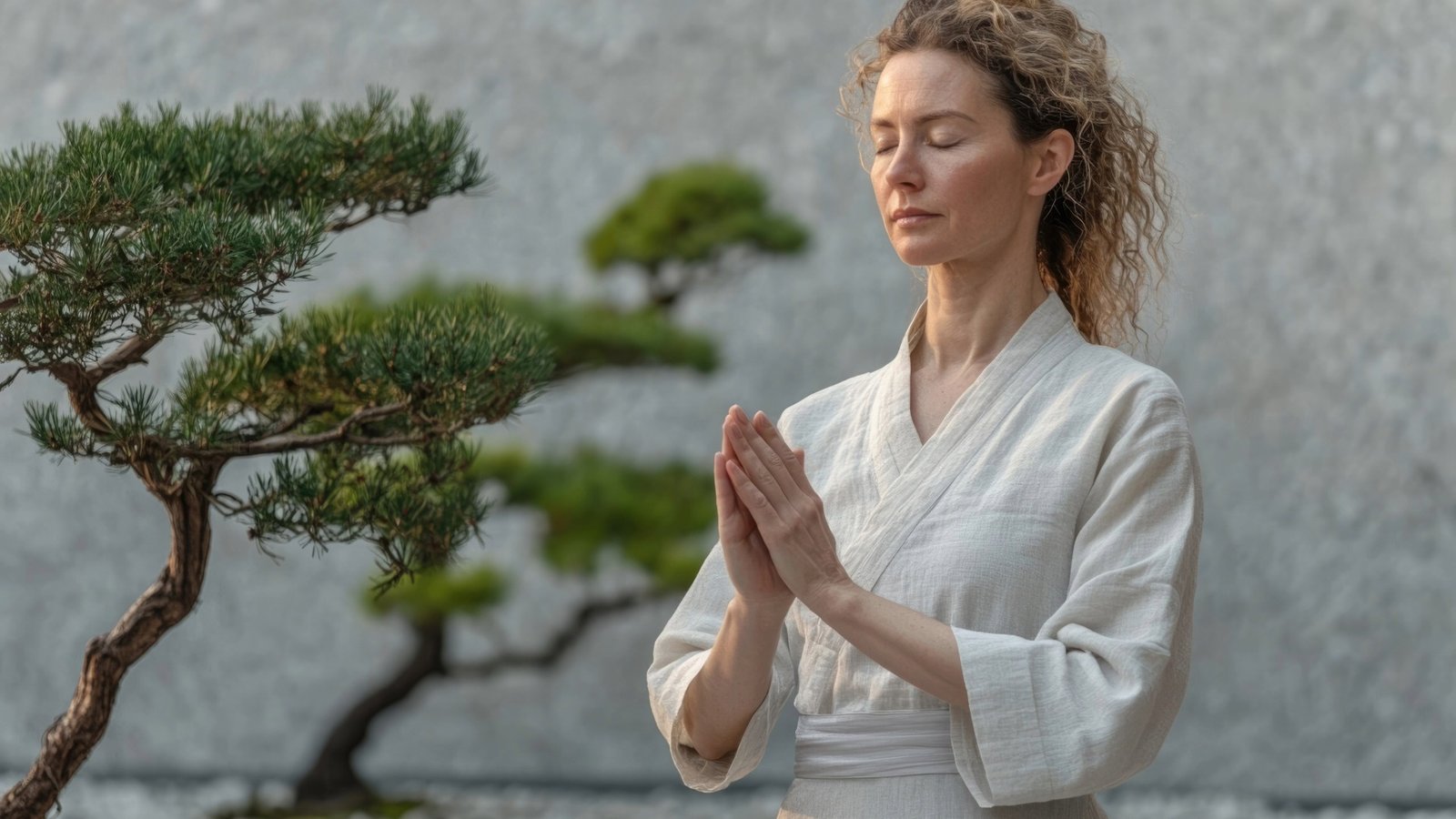
Creating the Space to Practise
Reiki practice does not require a perfect room, a special altar, or a complicated ritual.
What matters most is creating enough space—physically and inwardly—to become present.
Preparation is not about making Reiki “work.” It is about preparing yourself to practise with greater attention, calmness, respect, and openness.
A quiet environment can make it easier to notice your breath, your body, your thoughts, and your emotional state. Over time, the act of preparing for Reiki can also become a gentle signal to yourself:
For these few moments, I am allowed to slow down.
This is one of the simplest ways Reiki can become part of self-care rather than another task on an already crowded list.
Creating a Quiet, Supportive Practice Space
Choose a place where you can remain relatively undisturbed.
This might be:
- a quiet corner of your bedroom
- a comfortable chair
- your meditation space
- a yoga mat
- a peaceful outdoor area
- or simply the place where you normally sit or rest
You do not need to create a particular atmosphere for Reiki to be meaningful.
If you enjoy candles, gentle music, incense, crystals, plants, or other personal objects, you may include them. If you prefer simplicity, an uncluttered space can be equally supportive.
The purpose of the environment is not to create a magical setting. It is to help you feel comfortable enough to become present.
Comfort Comes First
Before beginning, consider your physical comfort.
You may want to:
- adjust the room temperature
- silence unnecessary notifications
- sit or lie somewhere supportive
- have water nearby
- use a cushion or blanket
- loosen restrictive clothing
- position your body so that you can remain comfortable without strain
There is no requirement to sit in a particular posture.
Reiki practice can be adapted to your body and your circumstances.
If sitting upright is uncomfortable, you can sit with support. If lying down is more comfortable, you can practise lying down. If you have limited mobility, use whatever hand positions are accessible and comfortable.
Your practice should support your wellbeing, not require you to ignore your body.
Grounding Before Practice
Grounding is a way of becoming aware of your present physical experience.
Before beginning Reiki, notice that you are here.
Feel the support beneath your body.
Notice your feet touching the floor, if you are standing or sitting. Notice the weight of your body against the chair, cushion, or bed.
You might quietly observe:
I am here.
I am supported.
I can take this moment slowly.
There is no need to imagine roots growing from your body or to perform a particular visualization unless that feels meaningful to you.
Grounding can be very simple.
You can notice:
- the sensation of your feet
- the weight of your hands
- the movement of your breathing
- the temperature of the room
- sounds around you
- the physical support beneath you
The goal is not to eliminate thought.
It is simply to return attention to the present moment.
Centering Yourself
After grounding, allow your attention to become more settled.
Centering can be understood as gathering your attention rather than allowing it to be pulled in many directions.
You might gently ask yourself:
How am I arriving at this practice today?
Perhaps you feel calm.
Perhaps you feel tired, distracted, restless, emotional, or completely neutral.
There is no incorrect answer.
You do not need to become calm before beginning Reiki.
Instead, begin by acknowledging what is already present.
This distinction is important.
Reiki practice is not an examination of whether you can produce a particular emotional or energetic state. It is an opportunity to practise awareness without immediately trying to change what you notice.
Gassho Meditation
Gassho is a traditional meditation practice associated with Reiki.
The word Gassho refers to bringing the palms together, traditionally in front of the chest.
Sit comfortably and bring your palms together gently. Allow your shoulders to relax. Close your eyes if that feels comfortable, or keep them softly open.
Place your awareness at the point where the tips of your two middle fingers touch.
Remain with this simple point of contact.
When a thought, feeling, sound, or sensation arises, simply observe it without judgment. Then gently bring your awareness back to where the two middle fingertips meet.
There is nothing to force and nowhere else you need to be. Each return is part of the practice.
You may begin with a few minutes and gradually allow the practice to become longer as it feels natural. Traditionally, Gassho Meditation may be practised for 15 to 30 minutes.
The Five Reiki Principles may be reflected upon before or after your meditation. Rather than treating them as rules to follow perfectly, you might simply ask:
What would it mean to practise this principle today?
Gassho Meditation can become a small daily pause—a moment of quiet attention in which you return to yourself and the intention behind your Reiki practice.
Posture and Physical Awareness
Your posture can be upright, relaxed, seated, supported, or lying down.
The most important consideration is that your body feels reasonably safe and comfortable.
Before beginning, scan your body gently.
Notice your:
- jaw
- shoulders
- neck
- hands
- chest
- abdomen
- hips
- legs
- feet
You may notice areas of tension.
You do not have to fix them.
Simply noticing can be enough.
If something feels uncomfortable, adjust your position.
This is an important part of self-care: listening to your body without turning that listening into another demand.
Gentle Self-Awareness
As you prepare for Reiki, you may notice physical sensations, emotions, memories, thoughts, or changes in attention.
Some practitioners may experience warmth, coolness, tingling, heaviness, lightness, relaxation, or other sensations.
Others may experience very little.
All of these experiences can be part of an ordinary individual practice.
You do not need to interpret every sensation as evidence of an energetic event.
Likewise, you do not need to assume that the absence of a sensation means that you are doing something incorrectly.
A useful principle is:
Notice without forcing.
You can remain curious without needing an immediate explanation.
This attitude becomes increasingly important as your Reiki practice develops.
A Contemplative View of Oneness
Reiki can also become an opportunity for deeper contemplation.
Within some spiritual interpretations of Reiki and other contemplative traditions, practice may gradually invite a sense that the boundaries between self and other, inner and outer, and individual and whole are not as absolute as they ordinarily appear.
You may choose to explore this as a contemplation of oneness with the cosmos.
For example, while sitting quietly, you might notice your breath and reflect on its relationship with the larger world:
You breathe in what the surrounding world provides.
You breathe out into that same world.
Your body exists within an environment rather than separately from it.
From this perspective, centering does not necessarily mean withdrawing from the world. It can also mean becoming aware of your participation in it.
This is an invitation for contemplation, not a belief that you are required to adopt.
And even when exploring non-duality, practical boundaries remain important.
A sense of interconnectedness does not remove individuality, consent, personal autonomy, or responsibility.
Oneness and healthy boundaries can coexist.
Opening a Reiki Practice
Once you feel reasonably settled, you can formally begin your Reiki practice.
There is no single required opening ritual.
You may simply bring your hands together in Gassho, rest your awareness at the meeting point of the middle fingertips, and allow yourself to become quiet.
You might set a simple intention, such as:
I open to Reiki with an open heart.
Or:
May this practice support my highest good and the highest good of all.
You may then silently acknowledge Reiki according to your own understanding and lineage.
If you work within a particular Reiki tradition, follow the opening practices you were taught.
The important element at Level 1 is not creating a complicated ceremony. It is learning to transition consciously from ordinary activity into intentional practice—and allowing yourself to rest, even briefly, in connection with Reiki and the wholeness of life.
A Simple Opening Sequence
You can use the following sequence before self-Reiki:
1. Arrive
Settle into your physical space.
2. Ground
Notice the support beneath your body.
3. Breathe
Observe a few natural breaths.
4. Center
Notice how you are feeling without judging it.
5. Gassho
Bring the palms together if comfortable.
6. Set your intention
Choose a simple intention for your practice.
7. Begin Reiki
Move naturally into your self-Reiki hand positions.
This entire preparation can take only a few minutes.
With experience, it may become an almost effortless transition.
Closing a Reiki Practice
Just as it can be helpful to begin intentionally, it can be helpful to end intentionally.
When you have completed your self-Reiki practice, allow yourself a few quiet moments before immediately returning to your day.
You might:
- bring your hands together in Gassho
- take several natural breaths
- notice your surroundings
- gently move your fingers and toes
- stretch if comfortable
- drink some water
- write a few words in your journal
There is no need to search for a particular result.
Simply acknowledge that the practice is complete.
You might quietly say:
My practice is complete. I return gently to the present moment.
Then allow your attention to return to your surroundings.
If you have been lying down, take your time before standing.
Preparation Does Not Need to Be Perfect
One of the easiest traps in any self-care practice is turning preparation itself into another source of pressure.
You do not need:
- a perfectly quiet house
- a certain time of day
- special clothing
- a particular meditation length
- a perfectly peaceful emotional state
- a collection of spiritual objects
- a specific physical posture
Life will not always provide ideal conditions.
Sometimes your Reiki practice may happen after a long day, in a small corner of your home, while the world around you continues making noise.
That is still practice.
The goal is not to create perfect conditions.
The goal is to learn how to return to presence within the conditions you actually have.
A Three-Minute Preparation
On days when you have very little time, try this:
Minute One — Arrive
Sit comfortably.
Feel the support beneath you.
Notice your surroundings.
Take a few natural breaths.
Minute Two — Center
Bring your attention inward.
Notice how your body and mind feel today.
There is nothing you need to change.
Minute Three — Intend
Bring your hands together in Gassho if comfortable.
Set a simple intention:
For these next few moments, I open to Reiki with an open heart.
Then begin your Reiki practice.
Three minutes is enough to create a meaningful transition.
You can always practise longer when time allows.
A Note on Practice and Experience
As you continue with Reiki, you may develop your own preparation routine.
Perhaps you will always begin with Gassho.
Perhaps you will spend several minutes in silence.
Perhaps you will prefer a short grounding exercise before placing your hands on your body.
Your routine may also change from day to day.
Allow that flexibility.
The purpose of preparation is not to create another ritual that must be performed perfectly. It is to cultivate a relationship with your practice that is steady, intentional, and sustainable.
Reflection
Before moving into self-Reiki, consider:
- What helps me feel present before practice?
- What does physical comfort look like for my body?
- Do I tend to rush into practice, or can I give myself a few moments to arrive?
- What happens when I notice my thoughts without trying to control them?
- What does “presence” mean to me?
- How might I explore interconnectedness or oneness without abandoning practical boundaries?
- What would a realistic Reiki preparation routine look like in my everyday life?
You do not need to answer these questions perfectly.
Let them become part of your ongoing practice.
Your Practice Begins With You
Preparation is the threshold between ordinary activity and intentional practice.
You pause.
You arrive.
You notice.
You breathe.
You create enough space to listen.
And then you begin.
At Level 1, this preparation is especially important because Reiki practice begins with your relationship with yourself.
Before learning how to offer Reiki to another person, you will spend time learning how to sit with yourself—quietly, consistently, and without demanding a particular experience.
That brings us to the foundation of the Reiki path:
Self-Reiki.
In the next chapter, we will explore the core self-Reiki practice, including hand positions, adaptation, intuitive awareness, and how to build a sustainable rhythm of practice.