
Beginning With Yourself
Reiki practice begins with you.
Before offering Reiki to another person, developing a distance practice, or eventually teaching others, Level 1 invites you to become familiar with your own experience.
Self-Reiki is therefore more than a technique.
It is an opportunity to develop presence, consistency, self-awareness, and a compassionate relationship with yourself.
You do not need to become perfectly calm before practising.
You do not need to understand every sensation.
You do not need to feel energy flowing through your hands.
And you do not need to practise for a long time every day.
The foundation is much simpler:
Show up.
Become present.
Place your hands comfortably.
Notice.
Allow.
Over time, these simple actions can become a steady part of your self-care practice.
Why Self-Reiki Comes First
The three levels of this Reiki path build progressively:
Level 1 — Self-Reiki and In-Person Practice
Level 2 — Deepened Practice and Distance Reiki
Master Level — Teaching and Certification
Self-Reiki remains relevant throughout all three levels.
Even after learning symbols, distance methods, and attunement practices, returning to self-Reiki can help you maintain a personal foundation.
This is important because Reiki practice is not only about what you can offer to others.
It is also about how you relate to your own inner experience.
A practitioner who continually gives without maintaining their own practice may eventually begin approaching Reiki as something they perform rather than something they live.
Self-Reiki provides a place to return.
Benefits of a Regular Self-Reiki Practice
A regular self-Reiki practice is a way of caring for yourself as a whole being. Through gentle, consistent practice, you deepen your relationship with Reiki and allow its presence to become part of daily life.
Holistic Healing
Reiki flows where it is most needed. It supports healing on the level of the physical body, mind, emotions, and spirit, recognising that each aspect of your being is connected.
Regular self-Reiki creates dedicated time to receive Reiki, rest your hands on your body with kindness, and support your natural return to balance, harmony, and wholeness.
Spiritual Awareness and Connection
Reiki is universal life energy. Through self-Reiki, you may deepen your awareness of this energy and of your connection with the greater wholeness of life.
As you become still and receptive, you may begin to experience more clearly that you are not separate from the universe. Self-Reiki can become a quiet return to this understanding of oneness.
A Deepening of Intuition
Daily self-Reiki can gradually strengthen your intuition. As you become quieter and more receptive, you may notice your inner guidance with greater clarity.
You may begin to recognize what your body, heart, and spirit need. Over time, you can learn to trust what you sense and to respond to yourself with more gentleness.
Emotional Balance and Inner Calm
Self-Reiki offers a regular pause from the demands of daily life. It gives you time to be with yourself without needing to solve, analyse, or achieve anything.
Through this practice, you may find it easier to meet your emotions with patience and compassion. Even a short daily practice can become a grounding ritual that helps you return to your centre.
Confidence in Your Connection with Reiki
Regular practice helps you develop trust in Reiki and confidence in your own connection with it. The more you practise, the more familiar Reiki becomes—not as an abstract idea, but as a living part of your experience.
Over time, you may feel ready to share Reiki with family members, friends, or pets. If you later choose to offer Reiki professionally, your personal self-Reiki practice becomes the foundation from which you serve others.
A Simple Self-Reiki Practice
There is no single hand-position sequence that every Reiki practitioner must use.
Different Reiki lineages and teachers may organize hand positions somewhat differently. Follow the specific instructions of your teacher or lineage where they differ from the general framework presented here.
For Level 1, however, you can begin with a simple whole-body sequence.
Before placing your hands, complete the preparation practice from Chapter 4.
Then allow your hands to rest gently on, or just above, different areas of the body.
You can remain with each position for several minutes, or move according to your own sense of what feels appropriate.
The purpose is not to locate a problem and attempt to fix it.
Instead, you are practising attentive presence.
Self-Reiki Hand Positions
Begin your self-treatment in Gassho. Place your awareness where the tips of the middle fingers meet. When you are ready, begin the hand positions.
Use a light, comfortable touch. The hands rest gently; they do not press or massage. Hold each position quietly for several minutes before moving to the next one.
Position 1 — Eyes
Place your cupped hands gently over your closed eyes, with the fingers resting across the forehead and the heels of the hands resting lightly on the cheekbones.
Keep the hands relaxed. Do not place pressure on the eyes.
Position 2 — Temples
Move your hands to the sides of the head, covering the temples and the area above the ears.
Let the fingers point upward and allow the palms to rest softly against the sides of the head.
Position 3 — Back of the Head
Place both hands behind the head, at the base of the skull.
If this is more comfortable, you may lie down and allow the head to rest in your hands.
Position 4 — Throat
Place one hand gently over the throat and the other at the back of the neck.
Use only a light touch at the front of the throat. There is no need to apply pressure.
Position 5 — Heart
Place both hands over the upper chest, one hand over the other if that is comfortable.
Rest here quietly.
Position 6 — Solar Plexus
Move both hands to the upper abdomen, below the rib cage.
Allow the hands to rest gently and remain still.
Position 7 — Lower Abdomen
Place both hands on the lower abdomen, below the navel.
This is the hara area: the physical centre of the body. Rest your hands here quietly.
Position 8 — Hips
Place your hands over the hip joints, one hand on each side.
If you are lying down, allow your arms and shoulders to remain as relaxed as possible.
Position 9 — Shoulders
Place one hand on each shoulder, or treat one shoulder at a time if this is more comfortable.
Position 10 — Upper Back
Reach both hands behind you and place them over the upper back, around the shoulder-blade area.
If reaching this area is difficult, treat the front of the body as fully as you comfortably can. Do not strain.
Position 11 — Lower Back
Move your hands lower, placing them over the area of the kidneys and lower back.
Rest here quietly.
Position 12 — Knees
Place your hands over your knees.
Treat one knee at a time if that is more comfortable.
Position 13 — Feet
Finish by placing your hands over the feet, or by holding one foot at a time.
When you have completed the positions, return your hands to Gassho for a moment. Place your awareness at the meeting point of the middle fingertips, then quietly complete your practice.
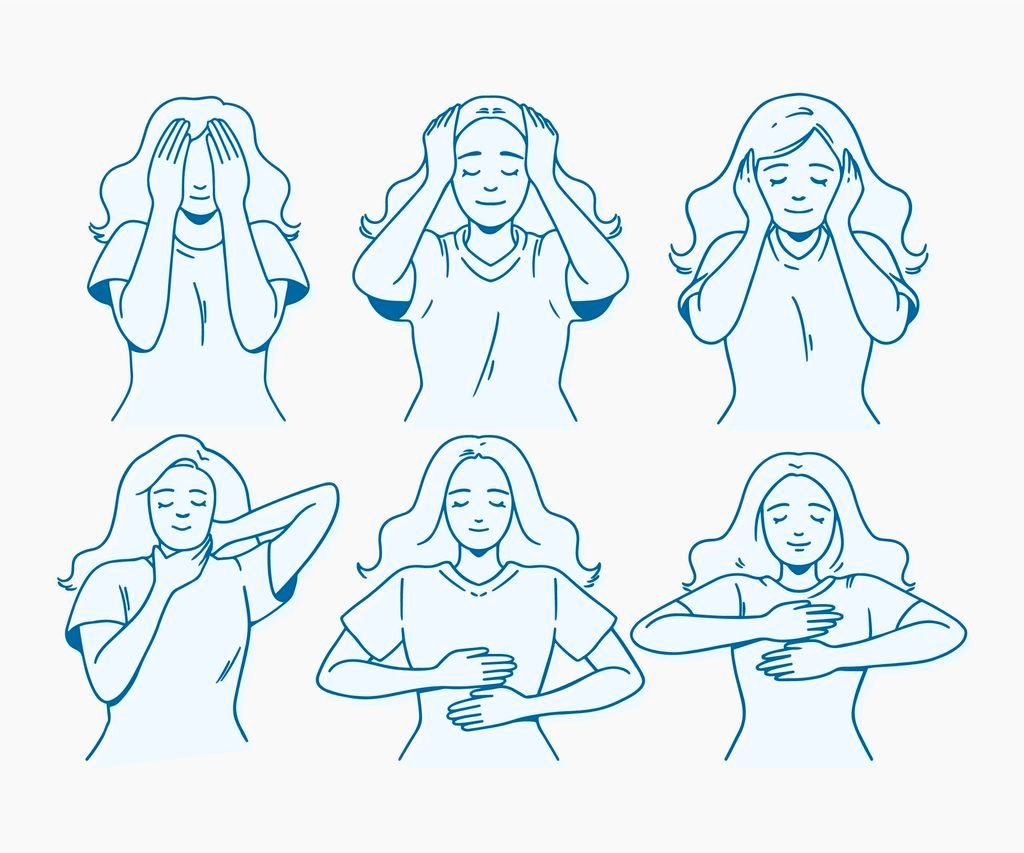
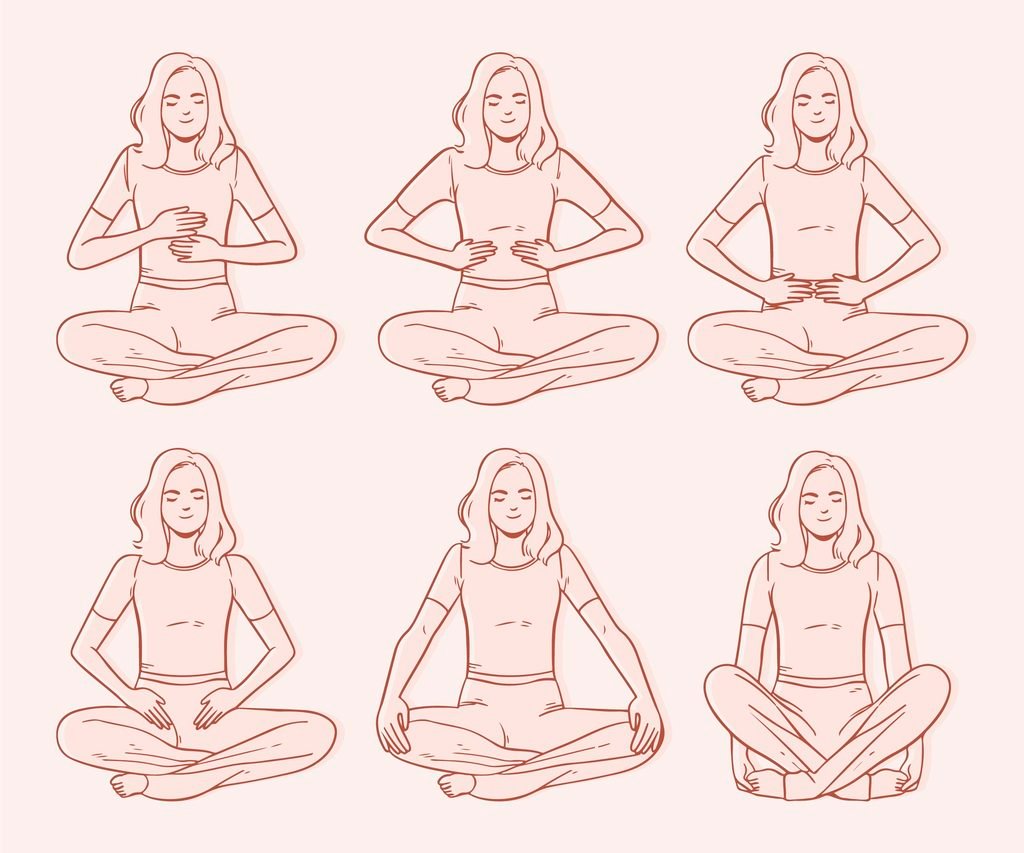
This illustration shows selected front-body self-Reiki hand positions. Continue with the upper-back and lower-back positions described in the text.
The Hands Do Not Have to Be Perfectly Positioned
One of the most important things to understand as a beginning practitioner is that hand positions are a framework, not a test.
You may forget the sequence.
You may place your hands slightly differently.
You may stay longer in one position.
You may skip positions.
You may discover that certain positions are more comfortable than others.
This does not mean that you have failed at Reiki.
The hand positions provide structure so that you have somewhere to begin.
As your practice develops, the structure can become more natural.
Hands-On, Hands-Near, or Hands-Off
Self-Reiki can be practised with different forms of hand placement.
Hands-On
Your hands rest gently on the body.
This can provide a direct sense of physical contact and may feel comforting.
Hands-Near
Your hands are held a short distance above the body without touching it.
This can be useful when touch feels uncomfortable or when a particular area is sensitive.
Hands-Off
Your hands remain away from the body while you maintain your intention and attention.
This can be useful when physical contact is not practical.
There is no requirement to use one approach exclusively.
Choose what feels safe, comfortable, and appropriate for you.
What Should You Feel?
This is one of the most common questions beginners ask.
The honest answer is:
There is no particular sensation you need to experience.
Some people describe sensations such as:
- warmth
- coolness
- tingling
- heaviness
- lightness
- pulsing
- relaxation
- emotional release
- increased awareness
- a sense of stillness
Others notice very little.
Your hands may simply feel like hands.
None of these experiences should be treated as a required measure of whether you are practising correctly.
Likewise, a strong sensation does not automatically mean that something profound or medically significant is happening.
Reiki is a spiritual and complementary wellbeing practice. Individual sensations during practice can have many possible explanations, and you do not need to assign a specific meaning to every experience.
Instead, cultivate curiosity.
Notice without forcing.
When Nothing Seems to Happen
There may be days when your Reiki practice feels deeply peaceful.
There may also be days when your mind wanders constantly.
Sometimes you may feel warmth or tingling.
Other times, you may feel absolutely nothing.
That is okay.
A practice does not become meaningful only when something unusual happens.
In fact, some of the most valuable aspects of self-Reiki may be much quieter:
- remembering to pause
- becoming aware of your body
- noticing your thoughts
- practising patience
- creating a moment of stillness
- developing consistency
- treating yourself with greater kindness
You do not need to chase an experience.
Let the practice be the practice.
Listening Inwardly Without Trying to Fix Yourself
Self-Reiki can develop your capacity for self-awareness.
As you place your hands on your body, you may notice that you are tired.
You may notice tension.
You may recognize that you have been carrying an emotion.
You may realize that you need rest.
You may discover that something in your daily routine is no longer supporting you.
These observations can be valuable.
But awareness does not require immediate correction.
Try replacing:
What is wrong with me?
with:
What am I noticing?
And instead of:
How do I make this go away?
you might ask:
What would be supportive right now?
This shift can transform self-Reiki from a practice of self-correction into a practice of self-compassion.
Self-Reiki and Non-Attachment
Non-attachment is an important attitude within many contemplative traditions.
In Reiki practice, it can mean allowing yourself to practise without demanding a particular outcome.
You can hold an intention without trying to control exactly what happens.
For example, instead of:
I must feel peaceful after this practice.
you might approach your practice with:
I am willing to be present with whatever I experience.
This does not mean becoming passive about your life.
You can still make decisions, seek support, change circumstances, or take practical action.
Non-attachment simply reduces the pressure to force a particular internal experience.
A Deeper Contemplation: Self and Whole
As your practice becomes quieter, you may occasionally experience moments in which your usual sense of separation feels less pronounced.
You may notice your breath as part of a larger environment.
You may become aware of your body as part of nature.
You may experience a sense of connection with other living beings or with the wider cosmos.
Some practitioners interpret experiences like these through the language of oneness or non-duality.
You do not need to adopt that interpretation.
It can simply be an area of contemplation.
You might sit with the question:
Where does “me” end and the rest of life begin?
There may be no need to answer.
The question itself can become part of the practice.
At the same time, remember the practical distinction introduced earlier:
A contemplative sense of oneness does not erase boundaries.
You remain an individual person with your own body, choices, needs, responsibilities, and autonomy.
Spiritual interconnectedness should never be used to override consent or personal boundaries.
Adapting Self-Reiki to Your Body
Your practice should be accessible to you.
If a particular hand position is difficult to reach, modify it.
If you cannot place your hands on your feet, place them on your thighs.
If you cannot comfortably place your hands on your chest, hold them nearby.
If you have limited mobility, practise only the positions that are accessible.
If touch is uncomfortable, use hands-near or hands-off positions.
If you become physically uncomfortable while practising, adjust your position or stop.
There is no spiritual achievement in enduring unnecessary physical discomfort.
Adapt the practice to your body rather than forcing your body to fit the practice.
A Short Self-Reiki Practice
You do not need an hour.
When time is limited, try a shorter sequence.
Three to Five Minutes
Begin with your hands over the heart or upper chest.
Take a few natural breaths.
Then move your hands to the abdomen.
Remain there for several breaths.
Finally, place your hands wherever feels grounding and comfortable.
Close with Gassho.
This can be enough for a brief daily practice.
Ten to Fifteen Minutes
Use three to five hand positions.
Spend a few minutes at each position.
Allow yourself to slow down without worrying about completing the entire body.
Longer Practice
When you have more time, you can work through a larger sequence of positions.
You may also include meditation, journaling, or quiet contemplation before or after Reiki.
The duration matters less than the quality of your relationship with the practice.
Building a Sustainable Rhythm
Consistency is usually more valuable than intensity.
A practice that lasts ten minutes and happens regularly may be easier to sustain than an elaborate hour-long routine that you abandon after a week.
Consider choosing a realistic rhythm.
For example:
Daily:
5–15 minutes of self-Reiki.
Several times per week:
10–30 minutes of self-Reiki.
Weekly:
One longer reflective practice combined with journaling.
These are examples, not requirements.
Your circumstances may call for something different.
The best practice is one you can realistically return to.
The 21-Day Integration Practice
Following Level 1 attunement, many Reiki traditions include a 21-day period of increased self-practice.
Within this manual, the 21-day period is approached as an opportunity for consistent self-observation and integration, rather than as a promise that a particular transformation will occur.
During this period, you may practise self-Reiki each day and record a few observations.
Your journal might include:
Date:
Practice duration:
Hand positions used:
What I noticed:
Mood before practice:
Mood after practice:
Anything I want to reflect on:
Keep the record simple.
The purpose is not to judge whether your practice is “working.”
It is to become more familiar with your own experience.
When You Miss a Day
Life happens.
You may become busy.
You may forget.
You may feel unwell.
You may simply not have the energy.
Missing a day does not mean that you have failed.
Return when you are able.
The purpose of a structured practice period is to develop a relationship with consistency, not perfection.
Instead of thinking:
I ruined the practice.
try:
I am returning today.
That is also practice.
Closing Your Self-Reiki Practice
When you have finished, return to the closing process from Chapter 4.
You may:
- Take several natural breaths.
- Notice the physical support beneath you.
- Bring your hands together in Gassho.
- Acknowledge the completion of your practice.
- Gently move your body.
- Return gradually to your surroundings.
You may quietly say:
My practice is complete. I carry its intention gently into the rest of my day.
Then continue with whatever comes next.
There is no need to remain in a special state.
Reiki practice is part of life—not separate from it.
Self-Reiki as an Ongoing Relationship
As you continue practising, your understanding of self-Reiki may change.
At first, you may focus primarily on remembering the hand positions.
Later, you may pay more attention to your breathing and internal experience.
Eventually, the formal sequence may become less important than the quality of presence you bring to it.
You may discover that self-Reiki is not something you perform perfectly.
It is something you return to.
Again and again.
Quietly.
Without force.
With curiosity.
With compassion.
With humility.
And with discernment.
Reflection
Before moving forward, consider these questions:
- What does self-Reiki mean to me beyond the physical hand positions?
- Which hand positions feel most comfortable and natural?
- What sensations do I notice during practice?
- How do I respond when I experience nothing unusual?
- Do I tend to judge my practice or simply observe it?
- How can I adapt Reiki to my actual body and daily circumstances?
- What practice rhythm feels realistic for me?
- What does non-attachment mean in my own practice?
- How might I explore interconnectedness without losing sight of healthy boundaries?
- What would it mean to approach myself with greater compassion?
Your Hands Become a Place to Return
Self-Reiki begins simply.
You place your hands on yourself.
You pause.
You breathe.
You notice.
And you stay.
Over time, those few minutes can become a familiar point of return—a way of creating space within the movement of everyday life.
This is why self-Reiki remains the foundation of the entire Reiki path.
The practice does not ask you to become someone else.
It begins by inviting you to become more present with the person already here.
In the next chapter, we will explore Level 1 Attunement—what attunement means within the Reiki tradition, how to prepare for receiving it, and how to approach the experience with openness, respect, and discernment.
Self-Reiki image designed by Freepik