

Reiki Level 2
Chapter 3 — Sei He Ki:
The Mental and Emotional Symbol
Harmony Within
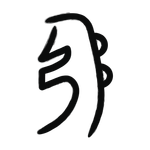
Sei He Ki (pronounced say hay key) is commonly known as the Mental and Emotional Symbol or the Harmony Symbol.
It brings Reiki into the realms of thought, emotion, memory, and habit, restoring harmony where something has become unsettled, strained, or held.
Mind, emotion, body, and spirit are not separate pieces of a person. A thought may stir an emotion; an emotion may be felt within the body; a memory may shape the way we meet the present. Sei He Ki supports healing across these layers while Reiki flows through the whole being, going where it is needed for the recipient’s highest good.
Form and Stroke Order
Sei He Ki is drawn in four strokes. Study the completed form and the direction of each stroke before beginning. The illustration below shows the form used throughout this manual.

Stroke 1 — Left-Hand Form
Begin at the top of the left-hand form and follow the line downward through its turns and curves. Complete the entire left-hand form as one continuous stroke.
Stroke 2 — Long Outer Line
Begin near the upper left and draw the long, sweeping line downward towards the lower right.
Stroke 3 — Upper Curve
Draw the smaller upper curve on the right in the direction shown in the illustration.
Stroke 4 — Lower Curve
Draw the smaller lower curve on the right in the direction shown.
When practising, observe:
- The continuous movement of the left-hand form
- The turns and curves within the first stroke
- The broad sweep of the long outer line
- The placement of the two smaller curves on the right
- The spacing and proportion between the different parts of the symbol
Follow the form shown and keep the stroke order consistent. Familiarity will develop through repetition.
Invoking Sei He Ki

To invoke Sei He Ki:
- Draw or visualise the symbol in its traditional stroke order.
- Repeat Sei He Ki three times, silently or aloud.
- Allow Reiki to flow.
You may draw the symbol with your hand, visualise its strokes within your mind, or bring the completed symbol directly into your awareness as it becomes familiar.
Traditional Uses of Sei He Ki
Sei He Ki may be invoked to support:
- Mental and emotional healing
- Calm and inner harmony
- The release of stored emotions
- Healing around memories and past experiences
- Transformation of habits and recurring patterns
- Clarity, concentration, and memory
- Self-acceptance and compassion
- Harmony within relationships
- Affirmations and Nentatsu Ho
- Any Reiki practice involving the mind or emotions
Sei He Ki does not require you to analyse the cause of an experience. You may know clearly what you wish to bring into Reiki, or you may simply sense that something within you is ready to receive healing.
Activating Sei He Ki With Cho Ku Rei
Cho Ku Rei activates and empowers other Reiki symbols. For this reason, it is usually drawn or visualised before Sei He Ki.
When invoking Sei He Ki, a common symbol sequence is:
Cho Ku Rei → Sei He Ki → Cho Ku Rei
To use this sequence:
- Draw or visualise Cho Ku Rei and repeat its name three times.
- Draw or visualise Sei He Ki and repeat its name three times.
- Draw or visualise Cho Ku Rei again and repeat its name three times.
After completing the sequence, place your hands where they naturally wish to rest and allow Reiki to flow.
Sei He Ki in Personal Practice
Sei He Ki may be brought into self-Reiki whenever you wish to support mental or emotional healing.
You might invoke it when the mind feels crowded, when emotions are moving strongly, when an old memory returns, or when a familiar pattern is ready to change. You may use it at the beginning of self-Reiki or at any point during the session.
After invoking the symbol, rest your hands upon the head, heart, abdomen, or anywhere else that feels natural. Thoughts and emotions may arise and pass. You do not need to follow, suppress, or interpret them. Remain with Reiki and allow the practice to unfold.
Habits, Intentions, and Nentatsu Ho
Nentatsu Ho, sometimes translated as thought transmission, thought treatment, or habit treatment, is a traditional Japanese Reiki technique for bringing Reiki to a thought, habit, intention, limiting belief, or recurring pattern. It may be practised upon yourself or offered to another person.
The technique pairs Reiki with a clear, positive affirmation expressed in the present tense, such as:
I am at peace.
The dominant hand is commonly placed upon the occipital ridge, where the base of the skull meets the neck, while the non-dominant hand rests upon the forehead. As Reiki flows, the affirmation may be repeated silently or expressed softly for several minutes. The hand upon the forehead may then be removed while the other remains at the back of the head for a few more quiet moments.
Nentatsu Ho is closely related to Seiheki Chiryo Ho, a habit-treatment practice found in later Japanese Reiki traditions. Depending on the lineage and level of training, it may be practised without Reiki symbols or combined with them.
At Level 2, Sei He Ki may be incorporated into Nentatsu Ho. Before beginning the technique, invoke Sei He Ki on its own or use the following sequence:
Cho Ku Rei → Sei He Ki → Cho Ku Rei
Allow Reiki to flow without trying to force the mind towards a particular result. Nentatsu Ho may be repeated regularly over several days or weeks when working with a particular intention; consistency is more important than the length of any individual practice.
When offering Nentatsu Ho to another person, agree upon the intention or affirmation beforehand. Allow the recipient to choose the habit, pattern, or change they wish to cultivate rather than imposing a suggestion upon them.
Offering Sei He Ki to Others

When offering Reiki to another person, Sei He Ki may be invoked before or during the session. You may draw or visualise it above the recipient, over your palms, or at a particular hand position.
The recipient does not need to explain every thought, memory, or emotion. They may share an intention if they wish, or simply receive Reiki without discussing the reason.
There is nothing you need to diagnose or unravel. Invoke the symbol, remain a clear conduit, and allow Reiki to carry out its healing work.
Becoming Familiar With Sei He Ki
At first, Sei He Ki may feel less immediately familiar than Cho Ku Rei. Its form is more fluid, and its movement may take time to remember.
Let familiarity develop through use. Draw it during self-Reiki. Visualise it in Gassho. Bring it into Nentatsu Ho, meditation, Reiki for others, or any other Reiki practice.
Gradually, the symbol becomes less like a form you are trying to reproduce and more like a doorway you know how to enter.
Harmony need not be forced. Sometimes it returns quietly.
Reflection
- What is Sei He Ki mainly used for?
- How do you use Cho Ku Rei to activate Sei He Ki?
- Would you like to incorporate Sei He Ki into your regular Reiki practice?
Optional Practice Companion
If you would like to explore Sei He Ki more deeply through drawing, practice, and reflection, Symbols as Doorways offers a gentle printable space for working with all three Level 2 Reiki symbols.

Symbols as Doorways
A Guided Reiki Level 2 Symbol Practice Journal
A 29-page printable journal for developing familiarity with Cho Ku Rei, Sei He Ki, and Hon Sha Ze Sho Nen through symbol forms, stroke order, pronunciation, invocation, traditional uses, drawing practice, reflection, and layered sequences.
The Path Ahead

Sei He Ki brings Reiki into the healing of thoughts, emotions, memories, and patterns. It supports harmony without requiring analysis and transformation without force.
In the next chapter, you will meet Hon Sha Ze Sho Nen, the Distance Symbol, through which Reiki may be offered beyond physical separation.
Reiki Level 2 Manual

- Chapter 1 — Entering Level 2
- Chapter 2 — Cho Ku Rei: The Power Symbol
- Chapter 3 — Sei He Ki: The Mental and Emotional Symbol
- Chapter 4 — Hon Sha Ze Sho Nen: The Distance Symbol
- Chapter 5 — Distance Reiki Methods
- Chapter 6 — Structuring a Distance Reiki Session
- Chapter 7 — Level 2 Practice & Certification
Come as you are.
Learn what calls to you, move at your own rhythm,
and return whenever you need a quieter place to begin again.