

Reiki Level 1
Chapter 5 — Self-Reiki: The Foundation of All Levels
Beginning With Yourself
Reiki practice begins with receiving.
Before you offer Reiki to another person, practise across distance, or eventually pass Reiki to others, you first become familiar with its presence within your own life.
Self-Reiki is the foundation of every level. Symbols, distance methods, and attunement practices may later deepen and expand your practice, but the simple act of placing your hands upon yourself remains a place to return.
You do not need to become perfectly calm before beginning. You do not need to understand every sensation or practise for a particular length of time.
Place your hands.
Allow Reiki to flow.
Begin where you are.
The Healing Gift of Self-Reiki

Reiki is a healing practice. During self-Reiki, its energy is received directly by your own body and being.
Reiki goes where it is needed, supporting healing on the physical, emotional, mental, and spiritual levels. As these aspects of your being are not separate from one another, healing in one area may quietly touch the others.
Regular self-Reiki may bring relaxation, renewed energy, emotional balance, mental clarity, spiritual connection, and a deeper sense of harmony and wholeness. It can also strengthen intuition as you become more receptive to the quiet guidance of your body, heart, and spirit.
The experience will not be the same every day. Sometimes Reiki brings a noticeable shift. Sometimes its movement is subtle. Healing continues according to Reiki’s wisdom rather than the expectations of the mind.
A Practice of Receiving

When offering Reiki to yourself, you are not using your own personal energy.
You are a conduit through which Reiki flows. At the same time, you are also its recipient. There is no need to generate energy, push it through the hands, or decide what must happen.
This makes self-Reiki different from another task to accomplish. You are not trying to perform it perfectly or produce a particular state.
You are allowing yourself to receive.
The hands rest.
Reiki flows.
Beginning the Practice

You may prepare in any of the ways explored in Chapter 4. You might create a quiet space, ground yourself, sit in Gassho, or hold a simple intention.
You may also begin by placing your hands upon your body.
If you wish to hold an intention, it may be spoken or silent:
I open to Reiki for my highest good.
or
May Reiki flow where it is needed.
These are only examples. Your own words—or the intention itself without words—are equally complete.
Let the hands rest gently on the body or hover a short distance above it. There is no need to press, massage, or make an effort.
A Whole-Body Sequence
Hand positions give beginners a comfortable structure from which to practise. They are not fixed points through which Reiki must enter, nor do they confine Reiki to the area beneath your hands.
Reiki flows throughout the whole being and goes where it is needed.
You may explore the following sequence:
Head
Cup the hands lightly over the closed eyes, without placing pressure upon them. You may then move the hands to the temples, ears, jaws, and, afterward, to the back of the head.
These positions allow the head and mind to rest quietly within the hands.
Throat and Neck
Place one hand lightly near or over the throat and the other behind the neck.
If touch at the front of the throat feels uncomfortable, allow the hand to hover above it or rest upon the upper chest instead.
Shoulders
Place one hand upon each shoulder, or rest upon one shoulder at a time if that is more comfortable.
Allow the shoulders and arms to soften beneath your hands.
Heart
Rest both hands over the heart or upper chest. The hands may lie side by side or one over the other.
Stay for as long as feels natural.
Solar Plexus
Move the hands to the upper abdomen, beneath the rib cage.
Allow the shoulders, arms, and abdomen to soften as Reiki flows.
Hara
Place both hands upon the lower abdomen, beneath the navel.
This is the hara, the physical and energetic centre of the body. Many people find this position naturally grounding and restful.
Back
Reach comfortably toward the upper back and then the lower back.
Do not strain to reach a particular area. If part of the back is difficult to reach, place your hands wherever they can rest comfortably and allow Reiki to flow where it is needed.
Hips, Knees, and Feet
Rest the hands upon the hips, knees, and feet in turn. You may treat both sides together or one side at a time.
If the feet are difficult to reach, place the hands upon the lower legs or thighs. Reiki is not limited by the exact position of your hands.
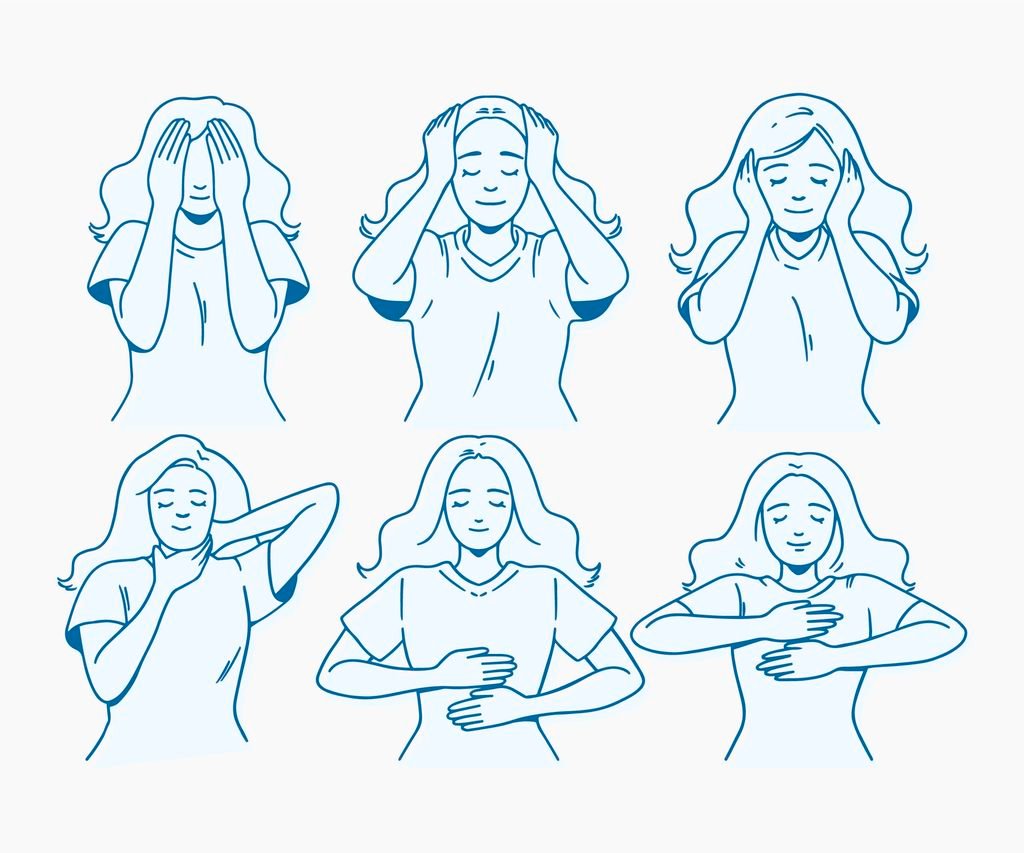
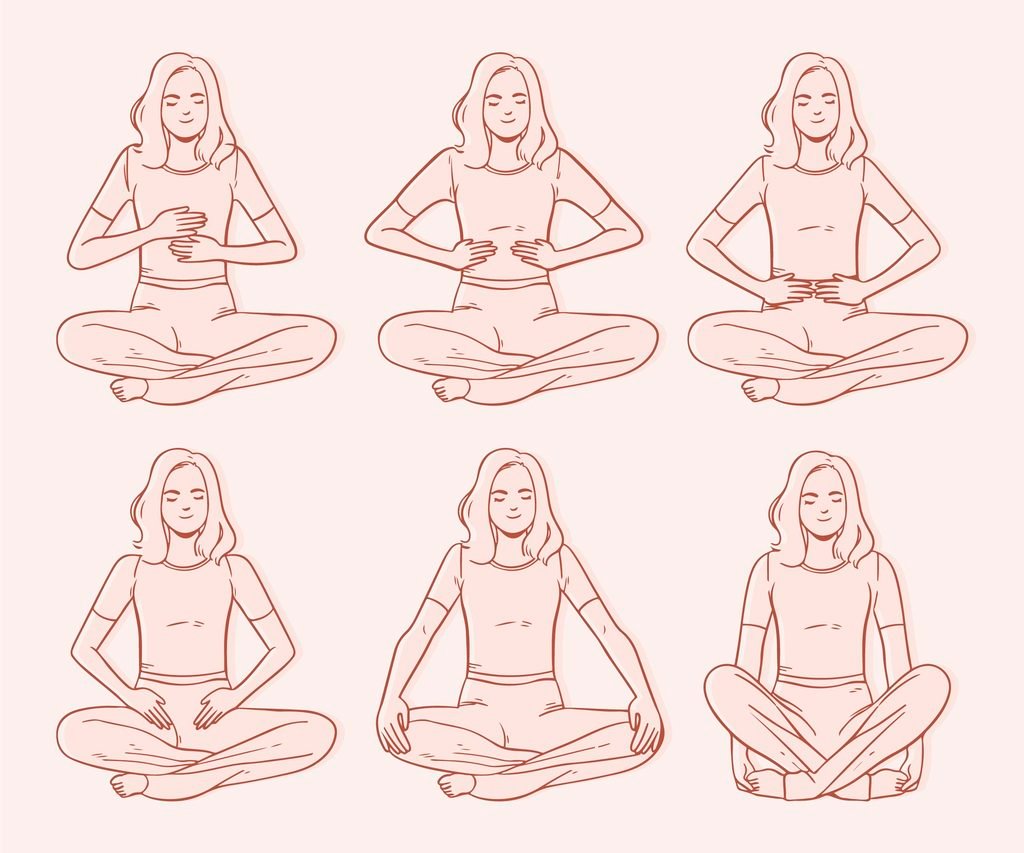
These illustrations show selected front-body self-Reiki hand positions. Continue with the upper-back and lower-back positions described in the text.
Self-Reiki illustrations designed by Freepik
Remain with each position for a few moments or several minutes. Move when it feels natural, and stop when the practice feels complete.
Let Your Hands Find Their Way

The sequence is a guide, not a test.
You may forget a position, change the order, remain longer in one place, or leave some areas out entirely. You may use the full sequence one day and place your hands only over the heart or hara the next.
Your hands may also be drawn naturally toward a particular area. You can follow this quiet inclination without needing to analyse it.
Moving the hands does not mean that you are directing Reiki or deciding where healing must occur. You are simply allowing the body and hands to find a comfortable form while Reiki moves according to its own wisdom.
As your relationship with Reiki deepens, the sequence may gradually become less important. The practice becomes simpler because trust has grown.
What You May Feel

During self-Reiki, you may notice warmth, coolness, tingling, pulsing, heaviness, lightness, emotion, imagery, deep relaxation, or stillness.
You may also notice very little.
In either case, Reiki is working.
A sensation is not required to prove that Reiki is flowing. Strong sensations do not necessarily indicate a deeper practice, and an apparently quiet session is not an unsuccessful one.
Let sensations come and go without chasing them or assigning meaning to each one. Reiki does not need to announce its presence in order to work.
A Practice for Everyday Life
A full-body practice may last as long as you wish, but self-Reiki does not require a large block of time.
When time is short, place your hands upon one or two comfortable areas. The heart, abdomen, or hara can each offer a simple place to rest. A few quiet minutes of receiving Reiki can be a complete practice.
When more time is available, move slowly through the whole body or remain wherever your hands feel drawn.
Daily self-Reiki is encouraged because regular practice allows your relationship with Reiki to deepen naturally. Yet consistency need not become rigidity. If you miss a day, return when you can. Nothing has been ruined.
Following your Level 1 attunement, a 21-day period of daily self-Reiki is traditionally recommended. This period offers time for integration and for becoming more familiar with Reiki. It is an invitation to practise, not a demand for perfection.
Beyond Giver and Receiver

Although we call this practice self-Reiki, the boundary between giving and receiving may gradually soften.
You are not producing energy and sending it to yourself. You are opening as a conduit while receiving the same Reiki that flows through you.
The hands rest upon the body. Reiki moves through practitioner and recipient together. For a while, there may be no need to separate the one who offers, the one who receives, and Reiki itself.
Nothing needs to be forced into oneness. As personal effort becomes quiet, separation may simply feel less important.
Closing the Practice

When the practice feels complete, let your hands rest for a moment.
You may bring them together in Gassho and thank Reiki:
Thank you, Reiki.
Gratitude may be spoken, silent, or felt without words. It reminds us that Reiki does not arise from personal effort. We receive it even as it flows through us.
Move gently, stretch if you wish, and return to your day.
The formal practice may end, while Reiki continues to unfold.
Reflection
Spend a few quiet moments with these questions:
- Which hand positions feel most natural and comfortable for me?
- Can I receive Reiki without searching for a particular sensation or result?
- What rhythm would allow self-Reiki to become a natural part of my life?
Let practice answer in its own time.
Your Hands Become a Place to Return

Self-Reiki begins simply: you place your hands upon yourself and allow Reiki to flow.
With time, this simple movement becomes familiar. Your hands become a place of rest, healing, and return—not because they hold Reiki as something personal, but because you have learned to open through them.
You do not need to become someone else before receiving Reiki.
Reiki meets you here.
In the next chapter, you will explore the foundational Reiki techniques that can deepen this relationship through meditation, awareness, and practice.
Reiki Level 1 Manual
- Chapter 1 — Welcome to the Reiki Path
- Chapter 2 — Reiki, Self-Care & Responsible Practice
- Chapter 3 — The Roots and Spirit of Usui Reiki
- Chapter 4 — Preparing Yourself for Reiki Practice
- Chapter 5 — Self-Reiki: The Foundation of All Levels
- Chapter 6 — Foundational Reiki Techniques
- Chapter 7 — Chakras & Self-Reiki
- Chapter 8 — Level 1 Attunement
- Chapter 9 — Offering Reiki in Person
- Chapter 10 — Level 1 Practice & Certification
Come as you are.
Learn what calls to you, move at your own rhythm,
and return whenever you need a quieter place to begin again.