


Reiki Level 1
Chapter 9 — Offering Reiki in Person
Sharing the Flow

Until now, your Level 1 practice has centred largely upon yourself. Through attunement and self-Reiki, you have begun to recognise how Reiki flows through your hands without being produced by personal effort.
You may now begin offering Reiki to another person.
Outwardly, the practice changes: another person is resting before you, and your hands are placed upon or near their body. Inwardly, the essence remains the same.
You do not manufacture Reiki or decide what the recipient needs. You become a clear conduit and allow Reiki to flow where it is needed for their highest good.
Before You Begin
Reiki may be offered to a friend, family member, practice partner, or client. Whoever the recipient may be, begin by asking whether they would like to receive Reiki.
Explain that they will remain fully clothed and may receive Reiki while lying down or sitting comfortably. Ask whether they prefer gentle hands-on Reiki, hands-near Reiki, or a combination of both.
Consent remains open throughout the session. The recipient may ask you to move your hands, avoid an area, change from touch to hands-near practice, pause, or stop at any time.
This need not become a formal conversation. A few clear questions are usually enough:
- Would you prefer hands-on or hands-near Reiki?
- Are there any areas you would like me to avoid?
- Would you be more comfortable lying down or sitting?
Once these preferences are understood, allow the recipient to settle.
Creating a Simple Space

A dedicated treatment room is not necessary. Reiki can be offered wherever the recipient can rest comfortably without being interrupted.
They may lie upon a massage table, bed, sofa, yoga mat, or other supportive surface. Reiki may also be received while seated in a chair.
Make sure the room is comfortably warm and offer a pillow or blanket if needed. Silence is perfectly suitable, although quiet music may be used if the recipient prefers it.
Candles, crystals, incense, essential oils, and special clothing are optional. They may add atmosphere, but they do not make Reiki more effective. Fragrance should only be used when you know the recipient is comfortable with it.
The space does not need to be perfect. It only needs to allow both people to rest within the practice.
A session may last around 20 to 60 minutes, depending upon the available time and the recipient’s comfort.
Preparing to Offer Reiki

Before beginning, take a quiet moment to settle.
You may bring your hands together in Gassho, practise one of the foundational Reiki techniques, or simply focus your mind upon Reiki.
You might hold the intention:
May Reiki flow to this person, going where it is needed for their highest good.
You may use different words, hold the intention silently, or begin without words when the intention is already clear.
There is no need to create a particular inner state before Reiki can flow. When you are ready, allow your hands to rest upon or near the recipient.
Hands-On and Hands-Near Reiki
Hands-on Reiki uses gentle, stationary touch. The hands rest lightly without pressure, massage, manipulation, or movement of the recipient’s body.
Hands-near Reiki is offered with the hands held a comfortable distance above the body. Reiki flows equally well without physical contact.
You may use either approach throughout the entire session or move naturally between them according to what has been agreed.
Use hands-near positions around the chest, pelvis, and any area where touch might feel sensitive or ambiguous. There is no need to reach beneath the recipient or place your hands anywhere that could disturb their sense of ease.
If you are uncertain, choose hands-near Reiki.
A Simple In-Person Sequence
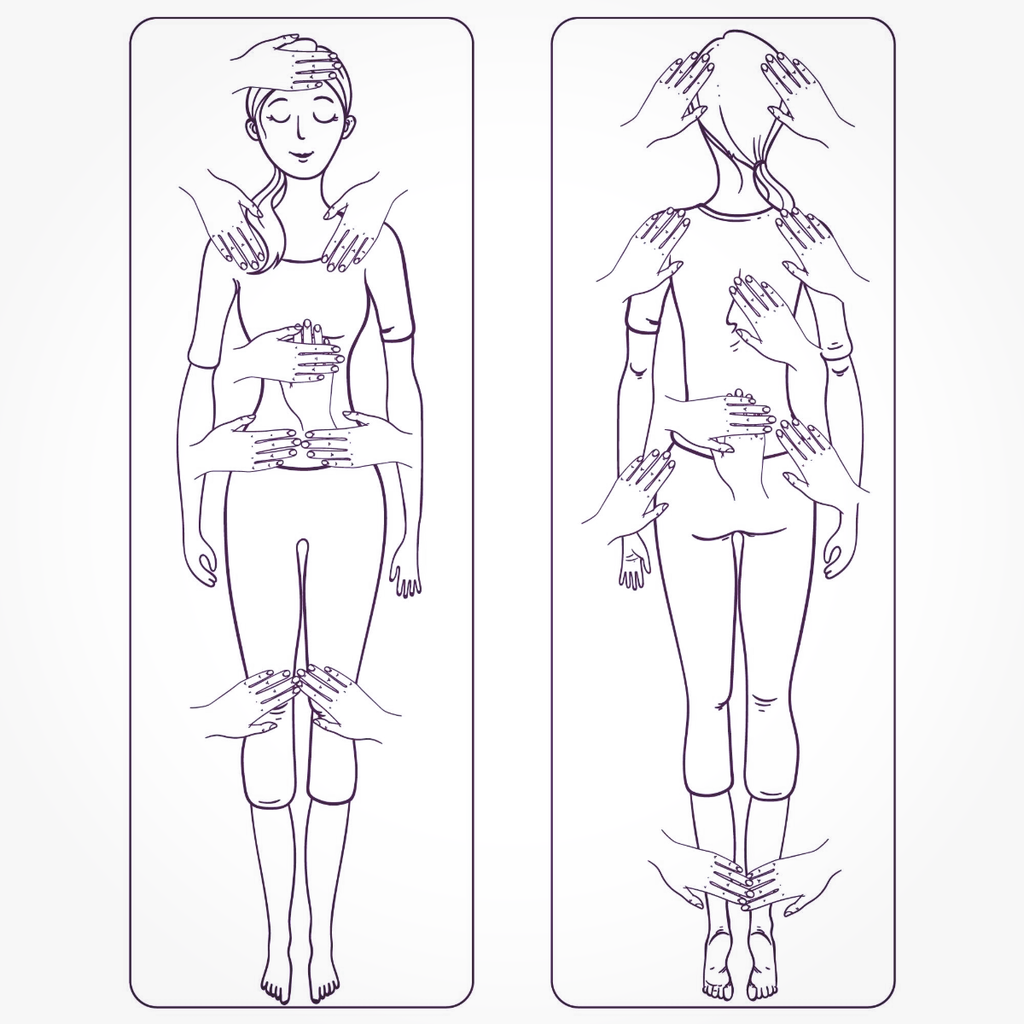
A hand-position sequence gives the session a gentle shape while you are learning. It is a guide rather than a set of rules.
Head and Neck
You may begin by resting the hands lightly upon or above the crown of the head.
Continue through any of the following positions:
- Forehead or temples
- Eyes, with the hands gently cupped and without pressure
- Ears and jaw
- Back of the head
- Neck
Choose only the positions that are comfortable for both you and the recipient.
Shoulders
Rest the hands gently upon the shoulders or hold them slightly above.
Allow your own shoulders and hands to remain relaxed. Reiki does not need to be pushed through the body.
Upper Body
Move toward the upper chest and heart area, using hands-near Reiki unless appropriate touch has been clearly discussed.
Continue toward the solar plexus and upper abdomen. The hands may rest above the body or lightly along the sides of the torso.
Lower Abdomen and Hips
Hold the hands above the lower abdomen and pelvic region, or place them comfortably beside the hips.
There is no need to touch intimate areas for Reiki to reach them. Reiki is not limited to the exact place beneath your hands.
Legs and Feet
Continue toward the thighs, knees, lower legs, ankles, and feet.
You may place one hand near each knee or foot, work with one side at a time, or hold both hands above the area together.
The feet often provide a natural place to complete a head-to-foot sequence.
The Back of the Body
A complete session can be offered while the recipient remains lying on their back. Turning over is optional.
If the recipient wishes to lie face down, you may offer Reiki to the:
- Shoulders
- Upper, middle, and lower back
- Hips
- Backs of the legs
- Feet
Make sure the recipient can breathe and rest comfortably. Use pillows or adjust the position whenever needed.
Letting the Hands Rest

Remain at each position for several minutes or for as long as feels natural. You do not need to divide the session evenly or watch the clock constantly.
At times, you may feel drawn to remain somewhere longer. Follow that inclination without needing to explain it.
Warmth, coolness, tingling, pulsing, heaviness, or stillness may be felt in your hands. You may also feel nothing unusual. Sensation is not required for Reiki to flow.
If an image, emotion, or impression arises, allow it to pass through without immediately turning it into an interpretation of the recipient. Your experience does not need to become a diagnosis or a message.
Let the hands rest. Let Reiki lead.
Reiki Cares for Both
While offering Reiki, you are not transferring your own energy into the recipient.
Reiki flows through you as a clear conduit. Because you remain within the flow, you are also receiving Reiki while you offer it to another person.
There is no need to strain, concentrate intensely, or sacrifice your own energy. If your hands, shoulders, or back become uncomfortable, change your position. You may sit, stand, move to the other side, or use hands-near Reiki in a way that allows your body to remain at ease.
Effort does not make the Reiki stronger.
As the need to produce an outcome softens, the practitioner can disappear quietly into the practice. There is Reiki, the resting of the hands, and the shared stillness in which both people are held.
The Recipient’s Experience
A recipient may feel warmth, coolness, tingling, emotion, imagery, relaxation, spaciousness, or stillness. They may fall asleep. They may remain awake and notice very little.
Whatever the experience, Reiki is working.
The recipient does not need to feel anything unusual to prove that Reiki has reached them. Reiki flows throughout the whole being, going where it is needed for their highest good.
Healing may unfold physically, emotionally, mentally, spiritually, or in ways that are not immediately visible. Release the need—or self-ego—to produce or prove a particular result.
Your role is to offer Reiki. Reiki carries the practice from there.
Closing the Session
When the agreed time has passed or the session feels complete, allow your final hand position to rest for a few more moments.
Move your hands away gently. You may bring them together in Gassho and silently thank Reiki, the recipient, and/or the shared time of practice.
Let the recipient know quietly that the session is complete. Give them time to become fully alert before sitting or standing.
Afterward, they may wish to describe what they experienced. Listen without telling them what they should have felt or deciding what the experience means on their behalf.
A simple question is enough:
How are you feeling now?
The session does not need to end with an analysis. Sometimes a few quiet words—and sometimes silence—complete it best.
Reflection

Before continuing, consider these questions:
- What should be agreed upon before an in-person Reiki session begins?
- How can hands-on and hands-near Reiki be used within the same session?
- Can I allow Reiki to flow without taking responsibility for directing the outcome?
One Practice, Quietly Shared
When offering Reiki to another person, there appear to be two roles: one person gives and another receives.
Yet the practitioner is also receiving Reiki, and the recipient is not separate from the same universal life-force energy flowing through the practitioner’s hands.
You are not the source of the healing. You are not required to know where Reiki should go. You are simply present within its flow.
A willing recipient.
A quiet place.
Your hands resting gently.
Reiki moving where it is needed.
That is enough.
In the next chapter, you will explore the quieter art of holding space—remaining present with another person without needing to fix, interpret, or carry their experience.
Reiki Level 1 Manual
- Chapter 1 — Welcome to the Reiki Path
- Chapter 2 — Reiki, Self-Care & Responsible Practice
- Chapter 3 — The Roots and Spirit of Usui Reiki
- Chapter 4 — Preparing Yourself for Reiki Practice
- Chapter 5 — Self-Reiki: The Foundation of All Levels
- Chapter 6 — Foundational Reiki Techniques
- Chapter 7 — Chakras & Self-Reiki
- Chapter 8 — Level 1 Attunement
- Chapter 9 — Offering Reiki in Person
- Chapter 10 — Level 1 Practice & Certification
Come as you are.
Learn what calls to you, move at your own rhythm,
and return whenever you need a quieter place to begin again.